How to Train Your AI: The Employee Onboarding Framework for Autonomous Agents
Stop configuring AI like software. Start onboarding it like an employee. Here's why your next AI agent needs the same 90-day training plan as your human hires.

Last month, a Series B SaaS company deployed their shiny new AI customer service agent. Cost them $50K in setup and integration. Within 48 hours, it was promising customers features that didn't exist, quoting prices from 2019, and telling one particularly frustrated user to "try meditation for stress relief."
Meanwhile, down the street, a smaller competitor spent the same amount but took a radically different approach. They treated their AI like they'd just hired a new customer success manager. Created an onboarding plan. Set up training sessions. Established clear boundaries.
Six weeks later, their AI agent was handling 70% of support tickets with a 94% satisfaction rate.
The difference? One company configured software. The other onboarded an employee.
The Mental Model Revolution
Here's the thing nobody's saying out loud: we've been thinking about AI completely wrong.
For the past year, every vendor has been pitching AI as this magical tool you plug in and watch the productivity gains roll in. Configure the API, connect your knowledge base, maybe tweak a few prompts. Done.
That's like hiring someone off the street, pointing at a desk, and saying "do customer support." How'd that work out the last time you tried it?
The companies actually succeeding with AI agents—not just playing with them—have figured out something critical. These aren't tools. They're digital employees. And just like that fresh college grad you hired last quarter, they need proper onboarding to become productive.
This isn't some philosophical exercise. The shift from "AI as tool" to "AI as team member" fundamentally changes how you deploy, manage, and scale these systems. When you configure software, you expect immediate results. When you hire an employee, you invest in their growth.
Why does this matter now? Because we've moved beyond simple chatbots. Today's autonomous agents can handle complex multi-step workflows, make decisions, and interact with multiple systems. They're less like calculators and more like junior analysts. And you wouldn't hand a junior analyst your entire customer database on day one without training.
The psychological shift matters too. Teams that think of AI as employees naturally ask better questions. Not "why isn't this working?" but "what does our AI need to learn to handle this situation?" Not "the AI made an error" but "we need to coach our AI on edge cases."
The Human-AI Training Translation Table
Let me show you exactly how traditional employee onboarding maps to AI training. This isn't theoretical—it's what companies are actually doing right now:
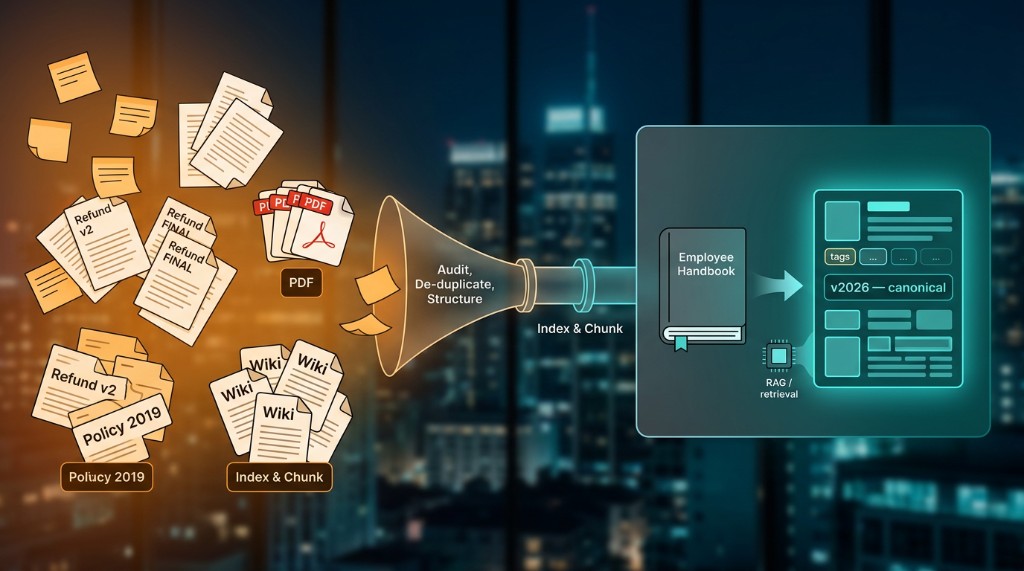 Messy sources in, one governed knowledge layer out—before RAG can work, humans have to impose order.
Employee Handbook → Knowledge Base
When humans join your company, they read policies, product docs, FAQs. Your AI needs the same foundation, but delivered through clean, structured data using RAG (Retrieval-Augmented Generation). One fintech startup spent two weeks cleaning their knowledge base before AI deployment. Found 14 different versions of their refund policy scattered across Notion, Confluence, and random PDFs. No wonder their first AI attempt was a disaster.
Job Description & Culture Fit → System Prompts & Persona
You hire humans for specific roles with defined personalities. Same for AI. Your support AI isn't your sales AI. A B2B logistics platform created separate "personas" for each department's AI agent. Their finance AI speaks in precise, formal language. Their customer success AI uses casual tone and emojis. Both trained on the same underlying model, completely different outputs.
Shadowing & Roleplay → Sandbox Testing
New hires shadow experienced employees. AI agents need sandbox environments where they practice handling edge cases before touching real customers. I've seen companies run thousands of test conversations, specifically targeting scenarios where the AI might hallucinate or overpromise.
Boundaries & Compliance → Guardrails
Humans know not to promise discounts they can't deliver or give medical advice they're not qualified for. AI needs these boundaries hardcoded. Not suggestions—rules. One e-commerce company learned this after their AI offered a "special 90% discount for being such a valued customer" to someone complaining about shipping.
"Let Me Ask My Manager" → Handoff Protocols
Smart employees know when they're out of their depth. Smart AI agents need the same recognition plus automatic escalation. The best implementations use sentiment analysis to detect frustration and immediately route to humans before situations explode.
The Four Pillars of AI Employee Onboarding
Pillar 1: Brand Voice Guide (The Actor's Approach)
Generic AI sounds like everyone else's generic AI. Want proof? Ask ChatGPT and Claude the same customer service question. You'll get professionally adequate responses that could come from any company on the planet.
The fix isn't complicated, but it requires work. Think of training your AI like preparing an actor for a role. You don't just say "be friendly." You break down the character.
Here's what actually works:
- Document specific phrases your best reps use
- Create before/after examples for common scenarios
- Define your "never say" list (mine includes "we apologize for any inconvenience")
- Set rules for formality, humor, emoji usage
One SaaS company transformed their AI responses by studying their top support rep's tickets. Turned out she never said "unfortunately." Always used "here's what we can do instead." Small change. Their AI CSAT jumped 12 points after implementing that single language pattern across all responses.
Pillar 2: Clean Knowledge Base (GIGO Principle)
Garbage In, Garbage Out. Oldest rule in computing, still true for AI.
Your AI is only as good as the information it's trained on. And I guarantee your internal documentation is messier than you think. That knowledge base you've been meaning to clean up for three years? Your AI will find every contradiction, outdated policy, and half-finished draft.
Before you train any AI:
- Audit all documentation for conflicts
- Establish single sources of truth
- Delete or archive outdated information
- Format consistently (AI performs better with structured data)
Pro tip: If you have multiple versions of the same information, your AI will creatively combine them into fiction. One B2B company discovered their AI was quoting prices by averaging three different rate cards from different years. Customers were thrilled. Finance was not.
Pillar 3: Establish Guardrails (The Anti-Persona)
Teaching your AI what NOT to do is more important than teaching it what to do.
This isn't about preventing AI takeover. It's about preventing your AI from making promises you can't keep, giving advice it shouldn't give, or handling situations beyond its scope.
Essential guardrails include:
- Topics completely off-limits (legal advice, medical recommendations, financial guarantees)
- Promises it cannot make (specific delivery dates, custom pricing, feature commitments)
- Situations requiring immediate human handoff (threats, legal issues, technical emergencies)
- Information it should never share (customer data, internal processes, competitive intelligence)
The best guardrails include graceful deflection language. Not "I cannot discuss that" but "For pricing questions, I'll connect you with our sales team who can create a custom package for your needs."
Pillar 4: Continuous Performance Management
Here's where most companies fail: they think AI training is a one-time event.
Your best employees didn't peak on day 90. They got better through regular feedback, coaching, and course corrections. Your AI needs the same continuous development.
Weekly AI performance reviews should include:
- Conversation audit sampling (read 50-100 actual interactions)
- Error pattern analysis (where does it consistently struggle?)
- Edge case documentation (what new scenarios emerged?)
- Prompt refinements based on real-world performance
- Knowledge base updates for new products/policies
One enterprise software company assigns an "AI Manager"—someone who spends 10 hours/week reviewing conversations, updating training data, and refining prompts. Their AI handles increasingly complex scenarios because someone's actively coaching it.
Advanced Strategy: Artificial Friction
Here's something counterintuitive that actually works: making your AI worse on purpose.
Some companies add 1-2 second delays before AI responses to complex questions. The AI knows the answer instantly, but the pause mimics human "thinking time." Users trust it more.
Others program their AI to occasionally say "Let me check that for you" followed by a brief pause, even when the information is immediately available. Or "I'm pulling up your account now" with a typing indicator.
It's psychological manipulation? Maybe. But users rate these "slower" AIs as more helpful and trustworthy than instant-response versions. We've trained people to expect human-speed service. Too fast feels inhuman.
One B2B platform tested this extensively. Same AI, same responses, but one version with artificial delays. The "slower" version had 18% higher trust ratings and 23% fewer escalations to human agents.
The ROI of Proper AI Onboarding
Let's talk numbers, because "it takes time" isn't a business case.
Companies properly onboarding AI agents see:
- 50-70% reduction in repetitive task handling by day 90
- 40% decrease in response time for routine queries
- 25-30% improvement in customer satisfaction scores
- 60% reduction in training time for new human employees (AI becomes the trainer)
Timeline reality check:
- Week 1-2: Knowledge base cleanup and initial configuration
- Week 3-4: Persona development and sandbox testing
- Week 5-8: Controlled deployment with heavy monitoring
- Week 9-12: Refinement and expanded scope
- Month 4+: AI operating at "full productivity"
Yes, that's three months. Same as a human employee. But unlike humans, once trained, AI agents work 24/7, never forget what they learned, and can be instantly cloned for other departments.
Implementation Roadmap
Ready to hire your first AI employee? Here's your 90-day plan:
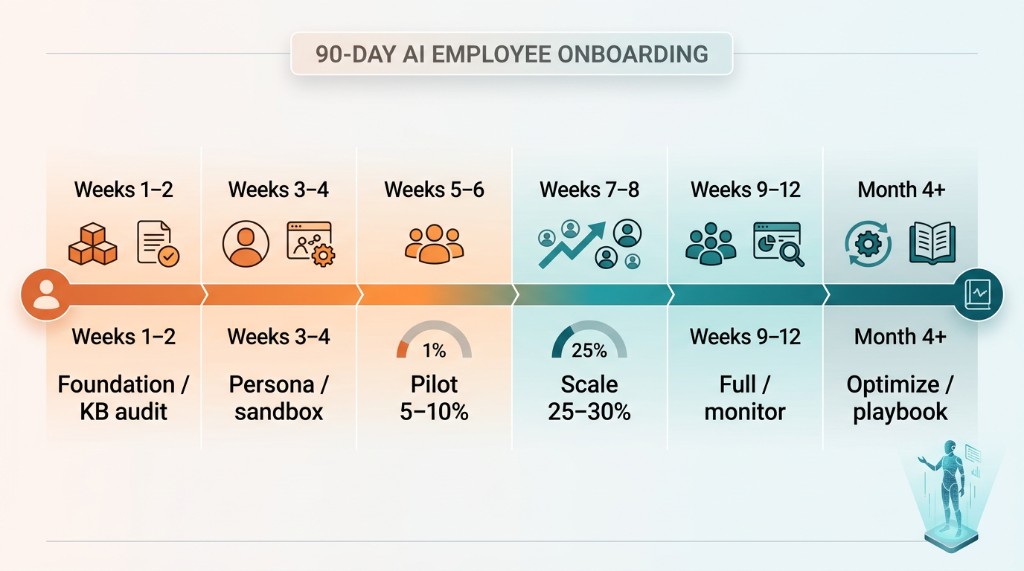 Treat the rollout like a hiring plan: narrow scope, measurable gates, then expand—same rhythm as a human probation period.
Week 1-2: Foundation Setting
- Audit and clean your knowledge base
- Define the AI's specific role and responsibilities
- Create initial persona and voice guidelines
- Set up sandbox environment for testing
Week 3-4: Initial Training
- Configure RAG system with clean data
- Write comprehensive system prompts
- Develop guardrails and handoff protocols
- Run 500+ test conversations
Week 5-6: Pilot Launch
- Deploy to small customer segment (5-10%)
- Monitor every conversation
- Document edge cases and errors
- Refine prompts based on real interactions
Week 7-8: Expanded Deployment
- Increase to 25-30% of target workload
- Implement artificial friction if needed
- Train human team on AI collaboration
- Establish weekly review process
Week 9-12: Full Deployment
- Scale to intended workload
- Shift to exception-based monitoring
- Document successful patterns
- Plan expansion to other use cases
Month 4+: Optimization
- Regular performance reviews
- Expand capabilities gradually
- Cross-train for other departments
- Build playbook for next AI "hire"
Your AI's First Day
Tomorrow morning, you could download an AI agent, point it at your customers, and hope for the best. Or you could treat it like you're hiring a new team member.
Create an onboarding plan. Set clear expectations. Provide quality training materials. Establish boundaries. Monitor performance. Give regular feedback.
The companies winning with AI aren't the ones with the biggest models or the fanciest integrations. They're the ones who understand a simple truth: AI agents are employees that need management, not magic tools that manage themselves.
Your next step? Pick one process—customer support, lead qualification, documentation—and design a 90-day onboarding plan for an AI agent. Start small. One role, one AI, one proper implementation.
Because in six months, you'll either have a collection of half-configured tools gathering digital dust, or you'll have a team of highly trained AI employees extending your human capabilities.
The difference comes down to day one. Will you configure software, or will you onboard an employee?
The choice—and the competitive advantage—is yours.
Ready to build AI Agents that actually work?
Human-in-the-middle AI Agent teams that perform real work. Coaching, rapid prototyping, and strategy with no fluff.
Book a Free Intro Call →Dispatch
Get the next field note
New articles, show notes, and practical lessons from the Strattegys AI crew.

 Morning Scrum
From Dev to Production: The Real Workflow for AI Agents
AI production is not just taking a Codex session and asking it to do the same thing fifty times. The workflow gets shaped in Session with Codex, then the repeatable parts move into faster, tighter production surfaces powered by bound tools and models like Groq.
 Spotlight
Privateering in the AI Caribbean: Riding the Waves of the Fifth Frontier
The Fifth Frontier Tech Wave Is Here. PC, internet, cloud, SaaS, AI: the same consolidation pattern keeps returning, and the privateer’s job is to find the viable lane between the great powers.
 Spotlight
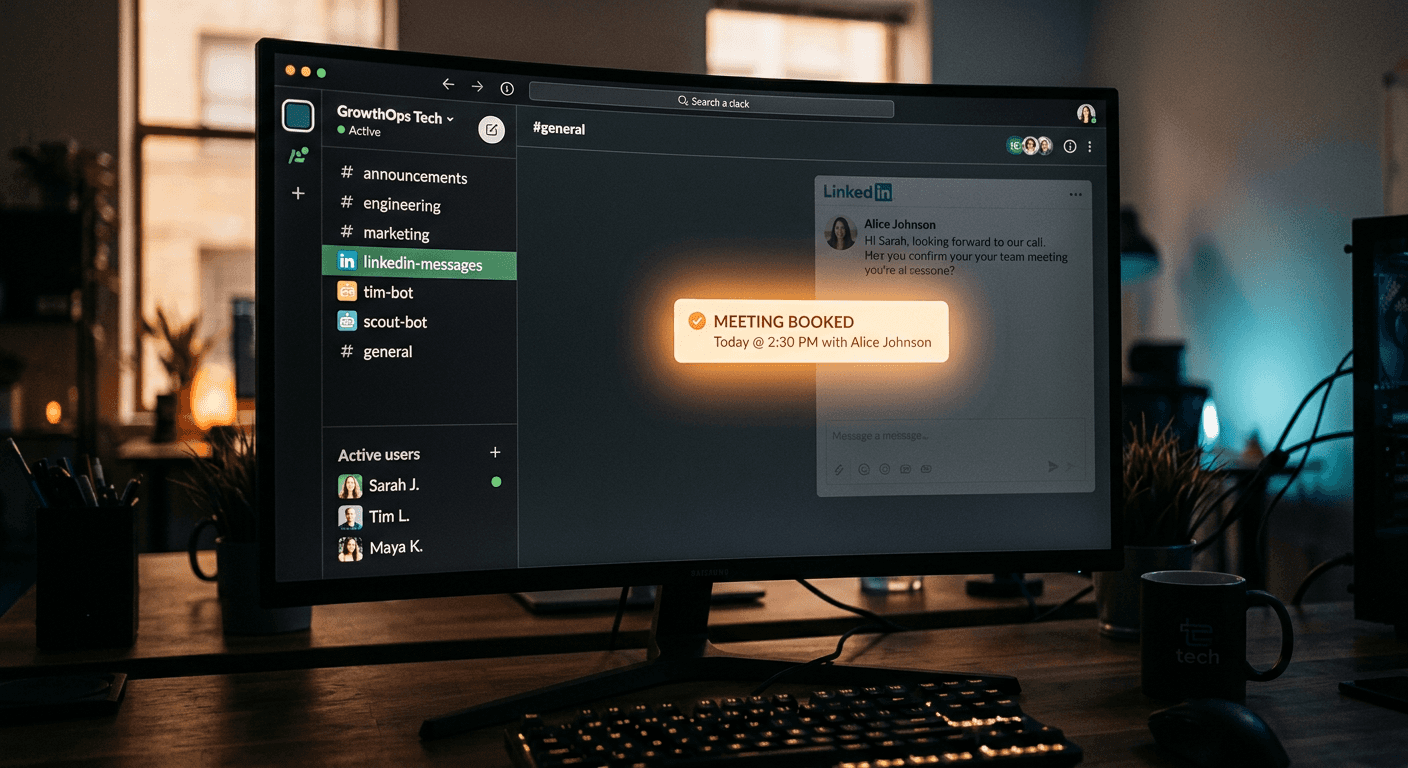
The First AI Managed Message from My Bot Tim, Just Booked a Call
My first AI-crafted LinkedIn message just booked a meeting. The bot researched the prospect, drafted the message in Slack, I approved it, and Tim sent it. The multi-agent future isn’t coming. It’s here.