Stop Throwing Mud at the Wall
It's 10 PM in Sweden, midday in Texas, and a guy just got caught eating a sandwich on camera. Welcome to The Sarah Factor! Three minds debate: how do you sell in the age of AI? Does the future belong to robots, researchers, or relationship builders? Spoiler: it might be all three.
How AI Simulations, Psychology, and Old-Fashioned Hustle Are Reshaping B2B Sales
With Govind Davis, Mike H & Magnus Kristensson
It's 10 PM in Sweden, midday in Texas, and somewhere in Washington state, a guy just got caught eating a sandwich on camera.
Welcome to The Sarah Factor — a weekly livestream where three very different minds collide over one big question: how do you actually sell things in the age of AI?
This week's episode brought together Govind Davis, a self-described builder who'd rather ship than strategize; Sir Michael Hohner (yes, he insists on the "Sir"), a research-driven go-to-market thinker working on AI simulation labs; and Magnus, a Swedish growth strategist who believes you can sell anything — anything — if you nail the psychology first.
What followed was an hour of spirited debate, real campaign data, regulatory rabbit holes, and a surprisingly profound argument about whether the future of sales belongs to the robots, the researchers, or the relationship builders.
Spoiler: it might be all three.

The 36 Personalities in the Room
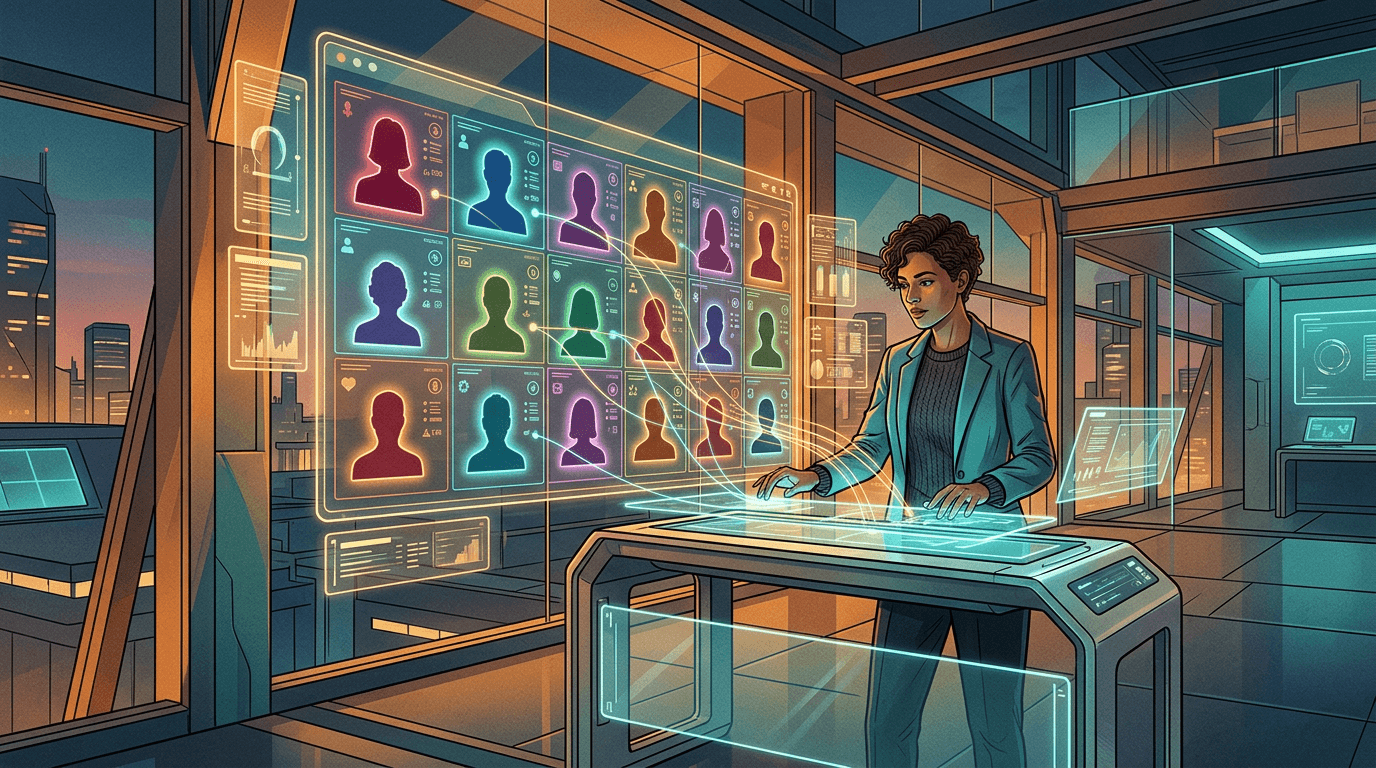
The conversation kicked off with Mike revealing a project that sounds like it belongs in a sci-fi film. He's been working with a simulation engineer in Europe to build what he calls an "AI simulation lab" — a Monte Carlo-style testing environment populated by 36 AI personas representing different buyer archetypes.
These aren't generic stick figures. Each persona is mapped to a specific management level (CXO, VP, director), a department (IT, legal, procurement, engineering), and plugged into a fictional — or real — company. The idea? Feed your sales messaging into the lab and see what comes out the other side.
The concept is essentially market research on steroids. What used to take weeks of focus groups and mainframe crunching can now happen in under an hour. Mike's lab simulates two distinct outreach approaches: the hard-hitting "show up and throw up" demo request, and the softer gift-of-information play. Each approach gets stress-tested against those 36 personas to see which messages land — and which ones crash and burn.
Magnus immediately saw the value but pushed for even more granularity. It's not enough to segment by job title and department — you need to understand how people process information. The analytical CFO doesn't respond to the same language as the visionary CTO.
The Regulatory Minefield Nobody Wants to Walk Through
Things got heated — in the best way — when the conversation turned to AI cold calling. Mike came loaded with research from Gemini, citing the TCPA (Telephone Consumer Protection Act) and new FCC enforcement actions that have ramped up since late 2025. His position was clear: AI agents making unsolicited calls in the US without prior written consent is playing with fire.
Magnus pushed back, drawing from his experience with European GDPR regulations. His argument was nuanced: privacy laws protect private individuals, not businesses during business hours. If someone's contact information is listed in a professional database like Apollo, and you're calling them about a business matter during working hours, that's fundamentally different from robocalling a consumer at dinner.
Govind played referee, landing somewhere in the middle.
Business landlines? Probably fine. Wireless numbers scraped from Apollo? That's where it gets dicey. The group agreed this deserves its own deep-dive session — and probably a real lawyer, since even AI can't reliably interpret its own regulations.
The practical takeaway?
Start with email. Get consent. Then layer in calling and texting. Mike's simulation lab is designed to optimize that first email touch so it actually earns the right to a follow-up.
The Great Debate: Send More Messages vs. Send Better Messages
This is where the philosophical fault lines really showed. Govind is a "chop wood, carry water" operator. He showed his live campaign data: working with Cetacean Labs (an open-source AI platform), he loaded 800 prospects from startup incubators into his system, sent about 40 LinkedIn connection requests, got 11 connections, 3 engagements, and 2 warm conversations — including one demo request.
His message? Dead simple: a clear value proposition and a human voice. No elaborate sequences. No AI-optimized subject lines.
Magnus respectfully disagreed — or rather, he agreed on the results but challenged the approach. His philosophy is rooted in inbound thinking: build a relationship first, deliver value through multiple touchpoints, let the prospect come to you with higher intent. Going direct means you only capture the people who happen to be ready right now. A nurture-first approach could double or triple the conversion from the same prospect pool.
He used a killer analogy: imagine walking into a physical sales meeting and immediately pulling out your product catalog. You'd lose the room. The same principle applies digitally, but it's even more critical because trust is harder to build through a screen.

Selling Feelings, Not Features
Magnus brought the conversation to what might be its most important insight: at the end of the day, you're not selling a product. You're selling a feeling.
He painted a vivid picture using car brands. A 300-horsepower engine in a Mercedes feels different than in a Volvo or a Kia. The specs are identical. The experience is not. The brands that win aren't the ones listing horsepower — they're the ones making you feel what that horsepower does to your morning commute.
Mike backed this up with a history lesson from the database wars of the 1990s. He was at Oracle when they crushed Sybase, Informix, and Ingress — companies that arguably had superior products. Oracle won on marketing, on Larry Ellison's personality, on the feeling of buying from the market leader.
Govind, the builder, took this as a friendly jab and owned it. But even he acknowledged the point. Product-market fit matters, but it's the story around the product that scales.
The AI Agent's Secret Weapon: Being Polite
One of the most practical insights came from Magnus's experience testing AI scheduling agents. The biggest failure point? Getting email addresses right. After trying to book meetings through AI voice agents, he found the system needed 10 to 20 attempts to correctly capture an email address by voice.
His solution was elegant: pre-load the AI with contact data from your CRM or prospecting database, then have the agent confirm the email rather than capture it fresh. And if there's a mismatch, send a text message to the prospect's cell for them to type it out.
Simple. Effective. Human.
But the bigger point was about how AI agents present themselves. Magnus argued that the agent needs to introduce itself as "Govind's personal assistant," ask permission to continue the conversation, offer to call back at a better time, and always give the prospect the option to speak with a human.
Govind agreed: there will be a pivot. Some people will resist talking to AI, but the sheer knowledge advantage of an AI agent — instant access to CRM data, product docs, and the entire internet — will eventually win people over.
The key is making that first interaction feel respectful, not robotic.
Where Do We Go From Here?
The Sarah Factor crew left the episode with clear next steps.
Mike is publishing his first simulation lab findings within a week, partnering with European collaborators to bring the product to market for software companies and consulting firms. Govind is scaling his outbound campaigns and refining his AI-to-article content pipeline. And Magnus is pushing all of them to think deeper about psychology, trust, and the long game.
The through-line connecting all three perspectives? Whether you're building a 36-persona simulation lab, firing off LinkedIn messages, or crafting emotionally resonant brand narratives, the goal is the same: say something that matters, to someone who cares, at a moment when they're ready to listen.
The tools are new.
The principle is ancient.
And somewhere in Sweden, it's almost midnight — but Magnus is still online, because great conversations don't watch the clock.
Dispatch
Get the next field note
New articles, show notes, and practical lessons from the Strattegys AI crew.

 Spotlight
The AI Sales Reality Check: Robots, Reactions, and the Rising Cost of Inference
When AI stops being a novelty and starts racking up "inference costs," the game changes. Join Govind, Magnus, and Mike H as they dive into AI SDRs, 36-personality Monte Carlo sales simulations, and the impending token economy shaping B2B sales in 2026.
 Spotlight
AI Can Generate a Page. LandingRabbit Wants to Make It Usable.
LandingRabbit is trying to solve the part of AI landing-page work that happens after the first draft: structure, editing, source context, feedback, and human judgment.
 Spotlight
AI Safety Has a Capital Allocation Problem
AI safety is usually treated as a lab problem. Aligned Institute is making a different bet: the next phase of safety depends on capital allocation, open research participation, operational risk intelligence, and governance systems that can survive contact with real AI deployment.