Everybody Is Trying to Do Everything With AI. Should They?

The AI superpower arc hits the scale wall. A feature on drawing the line — Ghost Studio, ScreenPAL, and the rebuild question.
Six to eight months of handing everything to AI ended at a scale wall of maintenance and edge cases. This is the arc — superpower, breakage, rebuild — and the question underneath it: what should AI do, and what should stay human?
The Superpower Phase
Six to eight months ago I decided to see what it takes to get AI to do everything. Not some things. Everything. Send my emails, write my emails, send them — all of it. I got pretty deep into it and built a lot of functionality around it, and for a while it felt like a superpower: dictating left and right while agents went and executed.
It's a seductive phase and, honestly, a necessary one. You have to go through the "AI does everything" period to learn what it's actually good at. I automated outreach, content, research, scheduling — if it was digital, I tried to hand it to a model. And the models complied, which is exactly the problem: they comply with everything, including the things they shouldn't be doing.
Then I tried to scale it up, and it broke. Not in one dramatic moment — in the slow accumulation of maintenance, edge cases, and mornings like the one I show below, where the app I built to run my life wouldn't load and I was back in the coding environment fixing it before I could do any actual work.
The Morning It Wouldn’t Load
My Ghost Studio is one of the most powerful things I have. Topics organized as tabs across the top, categories behind them, and an integrated chat bound to whatever I'm working on — it is designed exactly the way I want to work. I create a topic for the week, everything I produce lives inside it, and the AI always knows its context because the session is scoped to the topic. No vendor product does that, because no vendor product is me.
And then one morning I opened it to create a topic and it just wouldn't load. Something in the backend, who knows what — twenty or thirty minutes in the coding environment with the coding agent and it was fixed. Probably a nothing-burger. But the question stuck, and it's the question of this whole week: if you build super-apps that support yourself, they can be hyper-powerful — at the same time, you have to support them. You really have to ask: did I create extra value by doing this?
The Tool That Just Works
The same week I upgraded my ScreenPal subscription. After many attempts to give Ghost Studio its own recording, transcription, and AI video editing, I kept coming back to the same conclusion: it's just not worth it. They are great tools. The amount of time I'd spend getting AI to fix my video issues dwarfs the time it takes to just record and shape the experience myself.
Same story with streaming itself. Sure, I could use AI to control OBS — but it's still a nightmare for me. So I'm back on Restream, because as I put it in the stream: I'm gonna try to restream because it's easy. I can set everything up, click a few buttons, and somebody has figured this out in a way that just makes it so much easier. Every hour there's a new post declaring SaaS dead. It isn't. What dies is the undifferentiated middle — and what survives is whatever removes work instead of adding a new kind of work.
The Line, Part One: Attention
There are two balances to strike, and the first is your own attention: how many AI turns are you gonna do? And how much time are you gonna spend sitting at your desk all day, you know, waiting for AI turns to complete, checking the work, you know, it's exhausting. Nobody signs up for AI leverage to become a full-time AI babysitter. If your day is queueing turns and checking turns, you haven't automated anything — you've just changed desks.
My answer, learned across hundreds of turns, is speed over ceremony. I talk to the agent like it's a person — long conversational prompts, no prompt-engineering theater — and I use fast models (Muse, about a minute forty a turn) over frontier models that think for twenty or thirty minutes. If a turn takes thirty minutes, you get a few turns a day and every one has to be perfect. If a turn takes two minutes, you get dozens, you check each one yourself, and the iterative speed wins. More turns, checked by a human who knows what good looks like.
The Line, Part Two: Trust
The second balance is trust and quality — what you put out to the world. Let AI write a post unsupervised and go back and read it: it doesn't even make any sense sometimes. You're like, what is it even saying? Feed it your own language and instructions, though, and you get quality you wouldn't reach alone.
That's the cornerstone method the whole week is built on, verbatim from the stream: recording a 30 minute video, transcribing it, and then taking those ideas and building them into something useful beats having AI create content from a short prompt — nowhere near as effective. The machine multiplies what you feed it. Feed it your thinking, your voice, thirty minutes of real work — and it turns into a week of content. Feed it a one-line prompt and it turns into slop.
What the News Says
This isn't just my week — it's the whole industry renegotiating the same line (full roundup in our news piece):
- Reshape, not replace (BCG, Apr 2026). 50–55% of US jobs reshaped in two to three years; 10–15% eliminated in about five. Engineers amplified, call centers substituted — whether demand expands decides whether productivity becomes growth or cuts.
- The agency equation (Microsoft Work Trend Index 2026). As agents take execution, humans gain agency — if organizations are built to capture it. The premium skills are now quality control of AI output and critical thinking.
- The commitment lens (Beecker / Ro). Building faster is not maintaining faster. Building means committing to years of operational complexity; buying means absorbing someone else's maturity. Ask which parts you must own and which must simply work.
- The creator check. Hand-typed first-touch emails drew ~2.5x the replies of AI-written ones (Pin, 5M+ messages), and LinkedIn cut the reach of AI slop ~40%. Perspective beats production volume.
And yes, the displacement is real in pockets. Microsoft's early-retirement offers are the open version of the math every big company is running: repurpose ten people to replace a hundred where the work is routine. I don't read it as doomsday — the cloud did the same thing, and a new generation's first job became optimizing away the old buckets. But it is a transformation of how work happens, not a footnote.
The Trust Ladder: My Friday System
Where the rubber hits the road is the Friday cockpit: a campaign with a director (ten highest-priority actions a day), a researcher (find the companies, find the people, figure out how to reach them), and a sender (execute what's decided). Human interaction isn't a garnish on this system — it's the load-bearing wall. The director proposes; I say yes or no. That's a simple human gate, and getting it right at small scale is the entire job, because ramping up a broken gate just manufactures a bigger mess.
The rule, verbatim: I'm gonna go try to do five or 10 of these things, see exactly what happened, fine tune it, work out the kinks, then start adding it. Start with really small buckets. Give the AI the reins a little. Observe, monitor, approve — and as trust builds, scale it up. Low-risk actions (a connection request at the right company) can eventually go alone; relationship-bearing messages always pass through review. Right message, right time, right person — and the AI can't tell without training.
And none of it is set-and-forget. Some 180 things move through the system on a given day, jobs fail, counts misfire, and a human goes back into the coding tools to find out why. Verbatim: it's not set up and forget it. It requires constant monitoring and human intelligence. That monitoring layer — the human watching the machines watching the work — is itself the job now.
Close: What Stays Human
So here's my line, after six months of trying to erase it: AI extends what I can do — a thirty-minute stream becomes a week of content, a small team becomes a big operation — but the line holds where irreversibility starts. Messages sent in my name. Relationships touched. Things published. There, a human decides, having earned the judgment by staying in the work: What has to happen is I'm going to build things where I work with AI and enable myself to do more and to do better work. With AI, not instead of me.
Intent. Judgment. Taste. Accountability. Everything else — transcription, scheduling, first drafts, enrichment, monitoring dashboards — let the machine run. And keep asking the morning question: did I create extra value by doing this? If yes, keep building. If no, buy the tool and get back to work.
Further Reading
Every claim above traces to this week’s reporting — the full roundup lives on the news page.
Man vs Machine — What the News Says: 30 finds, niche first, big picture after.
Get the next field note
New articles, show notes, and practical lessons from the Strattegys AI crew.
 Insights
AI Safety Has a Capital Allocation Problem
What a conversation with Anthony Monroy and Aligned Institute reveals about sovereignty, open-source AI, and the infrastructure layer missing from AI risk.
 Featured
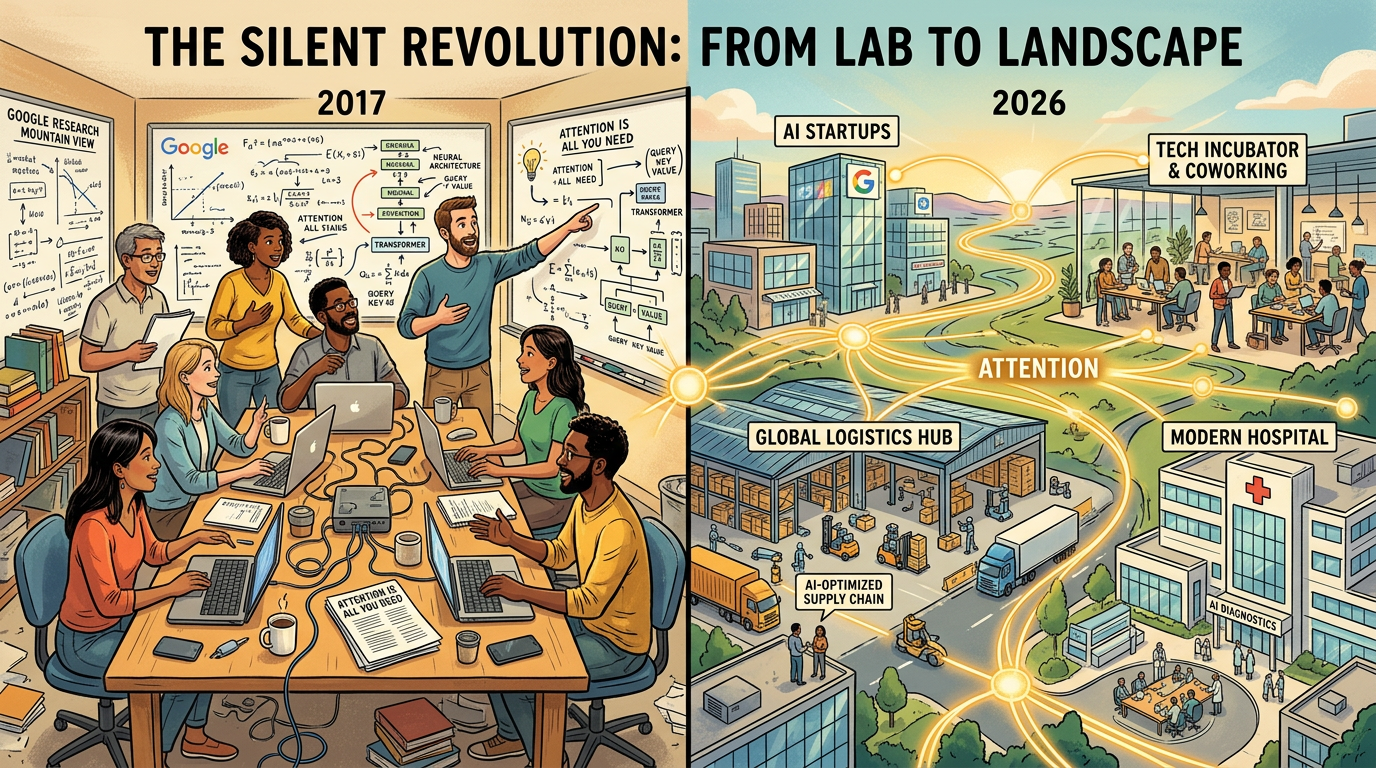
Are You Paying Attention to Attention Is All You Need?
Eight Google researchers published one 2017 paper, then quit to build companies from it. Here is what the transformer blueprint means for your business.
 Insights
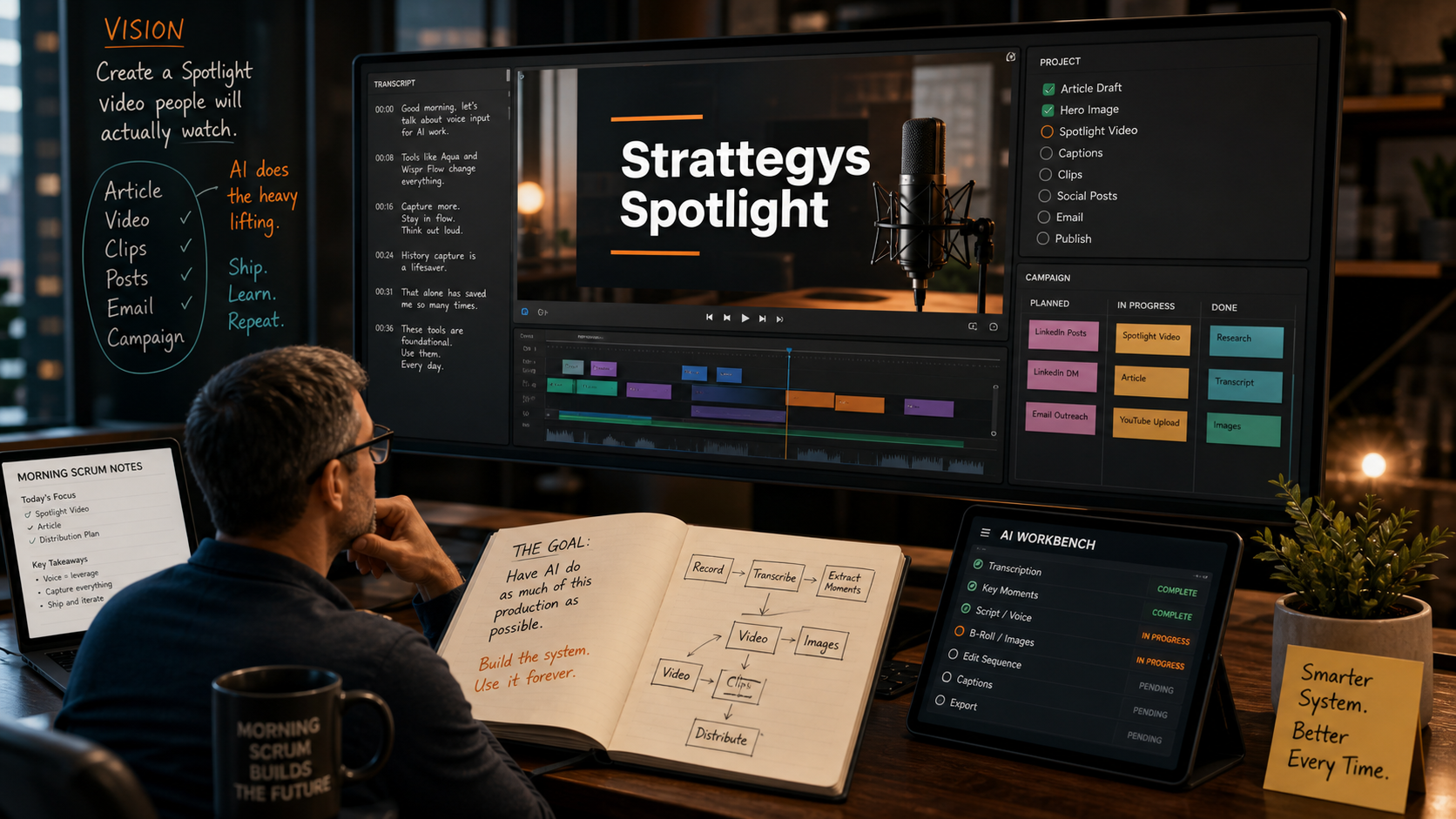
Building A Spotlight Video From A Live AI Workflow
A Morning Scrum field note on using AI to produce a Strattegys Spotlight package, and building the missing production tools as the work unfolded.

LandingRabbit
A website that matches what you sell — built from your ideas, slide decks, and sales notes.
Visit site →Your brand here
Get your founding sponsor spot now.
Become a founding sponsor
Inquire to learn about features, shows, and sponsor placements. No plans, no pricing sheets — just a conversation about fit.