Great Models, Broken Bridge: Why I Had to Use OpenCode Go to Build With Google’s Gemini 4 Argon
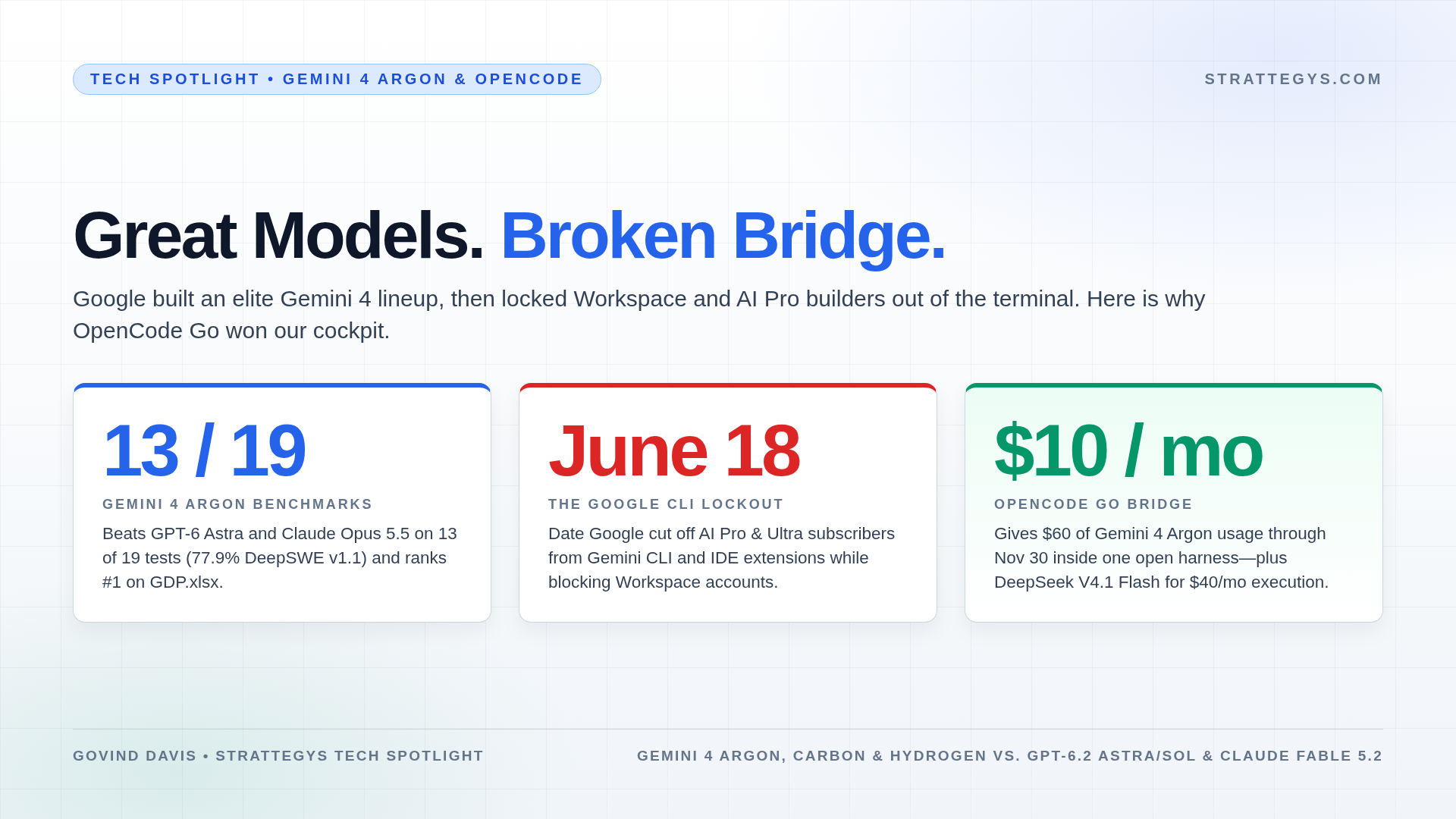
Google’s Gemini 4 Argon, Carbon and Hydrogen are frontier leaders, yet Google still has no coding subscription for Workspace and Cloud founders.
I am a PC and Google guy at heart. I use Google Workspace for my company email and documents. At some point I moved my entire infrastructure onto Google Cloud. When I sit down to build, I do not want to join a closed hardware tribe or pay a $200-a-month tax if I do not have to. So when Google dropped its new Gemini 4 model family over the past thirty days, I wanted Google to be my default coding answer.
This week I decided to test that wish in production. Every slide deck, every research synthesis, and every spec you are looking at in our NOV 16 Content Week was architected on Gemini 4 Argon. The output is fast, clean, and visually sharp.
Yet here is the paradox that prompted this Spotlight: even though I pay Google every month for Google Workspace and host my services on Google Cloud, I could not buy a simple, predictable coding subscription from Google to run Gemini 4 Argon in my terminal. To use Google’s flagship coding model without losing my mind in an IAM billing maze, I had to go through OpenCode Go.
The engine is a 10 out of 10: Argon, Carbon, and Hydrogen
Let us give Google’s model researchers full credit first. Early in the generative AI wave, Google was behind. Then they shipped a couple of strong Gemini releases, disappeared from the top of the coding conversation for six months, and suddenly showed up this autumn with three models that belong in the top tier of the industry:
- Gemini 4 Argon (launched Oct 13, 2026): Google’s frontier coding and enterprise knowledge model beats GPT-6 Astra, Claude Fable 5.1, and Claude Opus 5.5 on 13 of 19 published benchmarks, scoring 77.9% on DeepSWE v1.1, 68.9% on the Vals Index, 51.3% on AutomationBench, and #1 on OpenCode accuracy (45.3%). In a November 2026 paper benchmarking 20 frontier configurations on real professional workbooks (
GDP.xlsx), Gemini 4 Argon ranked #1 overall. - Gemini 4 Carbon (publicly available Nov 10, 2026): Rolled out at the same introductory API price as Argon—$2.00 per million input tokens and $10.00 per million output tokens through November 30 (with cached input tokens discounted by 95%)—and took the #1 coding spot on live leaderboards I pulled up on stream today.
- Gemini 4 Hydrogen (released Nov 12, 2026): Priced flat across its entire 1-million-token context window at $1.50 per million input tokens and $7.50 per million output tokens, and reported to outscore Argon on several fast agentic workflows.
Meanwhile, the rest of the frontier moved again today. On Tuesday, November 17—just eight days after Anthropic released Claude Fable 5.2 and Mythos 5.2 at $8 input and $40 output—OpenAI launched GPT-6.2 Astra and GPT-6.2 Sol across ChatGPT Work, Codex, and the API. OpenAI cut Astra’s API price by 20% from GPT-6 Astra to match Anthropic at $8 input / $0.40 cached / $40 output, while keeping GPT-6.2 Sol at $2 input / $0.10 cached / $10 output across a 1.05M context window (AI Weekly).
The four-silo Google maze: why a Workspace founder cannot buy a coding seat
If Google’s models are that strong, why isn’t every small and midsize technical founder running their coding stack on Google? Because Google’s product and billing packaging is shooting its own models in the foot.
“Argon beats GPT, Astra, and Claude on DeepSWE … 13 out of 19 benchmarks, it’s ahead. I’m like, okay. Google, you’re building this great stuff. But here’s the bit. There’s no subscription model.”
Govind Davis · Nov 17 morning scrum
Walk through what happens when a founder who already pays $30 to $40 a month for Google Workspace and hosts on Google Cloud tries to get a flat-rate coding agent from Google:
- Silo 1 — Google Workspace Business ($30–$40/mo): Gives you Gemini inside Docs, Gmail, and Gems with strict output caps—and zero access to a terminal coding agent. You cannot write application code with your Workspace seat.
- Silo 2 — Google AI Pro & AI Ultra (consumer plans): Want AI Ultra to access Gemini 4 Carbon in the Gemini app? The signup page demands a personal
@gmail.comaccount; business Workspace domains are blocked. Worse, on June 18, 2026, Google shut off AI Pro, AI Ultra, and individual access to Gemini CLI and Gemini Code Assist IDE extensions, pushing users toward a separate closed-source Antigravity CLI (The New Stack). - Silo 3 — Gemini Code Assist Standard & Enterprise ($19–$54/user/mo): Buried inside the Google Cloud Admin IAM console with annual commitment options and hard daily request ceilings (1,500 requests/day on Standard; 2,000/day on Enterprise). At one point I tried signing up for a $35 Google coding add-on; I never got it to authenticate properly, paid for nothing, and had to pry it off my bill.
- Silo 4 — AI Studio & Vertex AI metered billing: Instead of fixing the subscription wall, Google announced on November 13 that Google AI Pro and Ultra plans now include $10/month in Developer Program Cloud credits inside AI Studio (Enjoy.dev). It is a Rube Goldberg billing voucher where a single simple login should be.
It feels like Google Cloud was designed by committees whose job security depends on requiring six months of certification training just to configure IAM permissions. Even for Nano Banana image generation—which is fantastic and costs about 6.7 cents an image—you have to wire up a GCP project, generate an AI Studio token, and navigate Cloud billing.
The API pricing mirage: why $2/$10 is not actually cheaper than Claude
When you look at the API price chart on Slide 2 of our Spotlight deck—Gemini 4 Hydrogen at $1.50/$7.50, Argon and Carbon at $2/$10 introductory ($4/$20 starting December 1), and Claude Fable 5.2 or GPT-6.2 Astra at $8/$40—Google looks two to four times cheaper on paper.
In the real world of solo builders and small engineering teams, that price advantage is a mirage.
“Does this pricing look competitive? Yes. But in fact, it’s not. Because here’s the thing. Nobody pays for Claude Fable. … It’s about the subscription. You get a Claude subscription. You pay $200 a month, and you can use probably about as much Fable as you need.”
Govind Davis · Nov 17 morning scrum
Why is that? Because individual developers and small teams do not pay $8 per million input tokens and $40 per million output tokens to code with Claude Fable 5.2. Every paid Claude plan—Pro ($20/month) and Max ($100 to $200/month)—bundles terminal-native Claude Code (Pandromeda). An active developer on a $200 Claude Max plan who mixes Fable 5.2 for hard architecture with Sonnet and Haiku for routine edits is effectively paying one-fiftieth of list API rates—with a hard monthly ceiling and zero fear of waking up to a $900 token bill.
OpenAI just reinforced that exact bundle model today with GPT-6.2 Astra and Sol inside ChatGPT Work and Codex for Plus and Pro subscribers. Google is the only hyperscaler forcing its own Workspace business users onto raw per-token meters whenever they open a terminal.
How OpenCode Go bridged the gap—and how I run the hybrid stack
I spent plenty of time earlier this year on Claude and Codex. Frankly, I do not want to go back to Claude—it feels like the Mac vs. PC divide, where Anthropic is building a walled garden for a specific design tribe, and if you need API calls outside your $200 subscription you end up paying twice anyway. Moving to OpenCode and OpenChamber slowed me down for a few days while I adjusted, but it freed me from single-vendor lock-in.

More importantly, OpenCode solved the exact packaging problem Google refused to solve. Through November 30, 2026, OpenCode Go offers a $10-a-month promotion that includes $60 of Gemini 4 Argon usage (reflecting Google’s 50% introductory discount window). Inside my Ghost Studio model picker, I can select opencode-go/gemini-4-argon in one click—or switch to Gemini 4 Carbon and Hydrogen on standard OpenCode API routing.
Here is what my live field test of Gemini 4 Argon inside OpenCode showed this week:
- Where Argon wins: It is a powerhouse for 1-million-token context synthesis, parallel tool scripting inside OpenCode’s Code Mode runtime, and producing rich HTML slide decks, inline SVGs, and self-contained specs.
- Where it burns budget: Even with the $10-for-$60 promo, running Argon across a full multi-file codebase burns through credits quickly—and on December 1, 2026, Argon and Carbon introductory API rates double from $2/$10 to $4/$20.
- Privacy caveat to watch: On OpenCode Go’s discounted Gemini 4 Argon Contributor tier, Zero Data Retention (ZDR) is not enabled—Google may use prompts and completions to train future models. Keep proprietary client code on a paid ZDR key.
That led me to the hybrid workflow I am running right now:
- Use Gemini 4 Argon for the non-coding studio and spec work (~20% of tokens): Producing weekly research, 16:9 HTML slide decks, video trims, and 2,000-word article specs in Ghost Studio does not carry the massive repo context of a full code build. Argon makes the outputs cleaner and prettier without blowing the budget.
- Use DeepSeek V4.1 Flash as the daily coding workhorse (~80% of tokens): When I switch over to OpenChamber to write and refactor application code all day, I run DeepSeek V4.1 Flash (552B total parameters on a Causal Encoder-Decoder backbone with only 8B input / 16B output active parameters, MIT-licensed open weights, priced around $0.05 to $0.15 per million input tokens and $0.57 output). You cannot buy a DeepSeek subscription either, but at those unit rates I can run DeepSeek flat-out all month for about $40.
Longer term, I suspect the industry will split between one-stop frontier models for people who do not want to think about routing, and hyper-specialized domain models—imagine a compact, blazing-fast model trained exclusively on Python or UI layout that beats every giant general-purpose LLM at atenth of the cost.
Three fixes Google should ship tomorrow
I am spotlighting this because I want someone on the Google Workspace or Google Cloud team to fix it. If Google wants to win the millones of technical founders and small businesses already paying for Workspace, it only takes three moves:
- 1. Add a $50/month Builder Seat directly onto Google Workspace bills. Never tell a business founder they need a personal
@gmail.comaccount to buy AI Pro or Ultra. Let me check one box in my Workspace admin billing and get pooled monthly coding usage across Gemini 4 Argon, Carbon, and Hydrogen with business ZDR included. - 2. Let that subscription authenticate in OpenCode and the terminal. Reverse the June 18 CLI lockout. Let builders log in with OAuth inside OpenCode, VS Code, or Gemini CLI—the exact same way developers log in with a Claude or ChatGPT subscription.
- 3. Simplify the Cloud Run & Vertex path for small teams. Stop designing every AI tool as if the buyer has a six-person DevOps team with GCP certifications. Make deploying an AI-built app from OpenCode to Google Cloud as frictionless as Cloudflare or Hugging Face.
Have you found a clean way to code inside Google’s ecosystem—or did Google’s subscription maze push you into a third-party harness too?
Sources & Further Reading
- Google Blog, Introducing Gemini 4 Argon
- Gemini 4 Argon 19-Benchmark Breakdown (77.9% DeepSWE v1.1)
- arXiv, GDP.xlsx: Benchmarking Frontier Models on Professional Workbooks (Argon #1)
- Google Blog, Gemini 4 Carbon Public Availability (Nov 10, 2026)
- Google Blog, Introducing Gemini 4 Hydrogen ($1.50/$7.50 Flat Across 1M, Nov 12, 2026)
- SiliconANGLE, Hydrogen Outscores Argon; Dec 1 Price Doubling to $4/$20
- OpenAI, Introducing GPT-6.2 Astra ($8/$40) and GPT-6.2 Sol ($2/$10) (Nov 17, 2026)
- AI Weekly, GPT-6.2 Astra Cuts API Price 20%
- Anthropic, Introducing Claude Fable 5.2 and Mythos 5.2 ($8/$40, Nov 9, 2026)
- Google Developers Blog, June 18, 2026 Gemini CLI & Code Assist Consumer Cutoff
- The New Stack, Google Pushes Pro and Ultra Users from Gemini CLI to Antigravity CLI
- Enjoy.dev, Which Apps Can Use Google AI Pro or Ultra in Nov 2026
- Google Blog, Developer Program Cloud Credits in AI Studio (Nov 13, 2026)
- OpenCode Go Documentation, Gemini 4 Argon 50% Promo & Contributor ZDR Terms
- AI Model Directory, DeepSeek V4.1 Flash Specs & Pricing
- arXiv, DeepSeek-V4.1-Flash 552B / 8B-16B Causal Encoder-Decoder Architecture
Related this weekFeature: The One-Third That Works — Why Human-in-the-Lead AI Beats Autonomous Sprawl
Read the feature →
Get the next field note
New articles, show notes, and practical lessons from the Strattegys AI crew.
 Featured
Privateering in the AI Caribbean: Riding the Waves of the Fifth Frontier
The fifth frontier: PC, internet, cloud, SaaS, AI all consolidated the same way. Finding the privateer’s viable lane between the great powers.
 Insights
See How AI Changes the Calculus for GTM Strategy
What we learned from a Mirror Teams strategy session about how AI lowers the barriers, increases the speed, and changes the output of go-to-market analysis.
 Learn
Should AI Do This or Should I?
Should AI do this, or should you? A five-question checklist, a build / buy / delegate / keep scorecard, and a five-task exercise.

LandingRabbit
A website that matches what you sell — built from your ideas, slide decks, and sales notes.
Visit site →Your brand here
Get represented on the rack.
Get represented on the rack
Inquire about representation — coverage, qualified meetings, and deal support. No plans, no pricing sheets, just a conversation about fit.