Ten desk moves for the minutes you spend waiting on a model
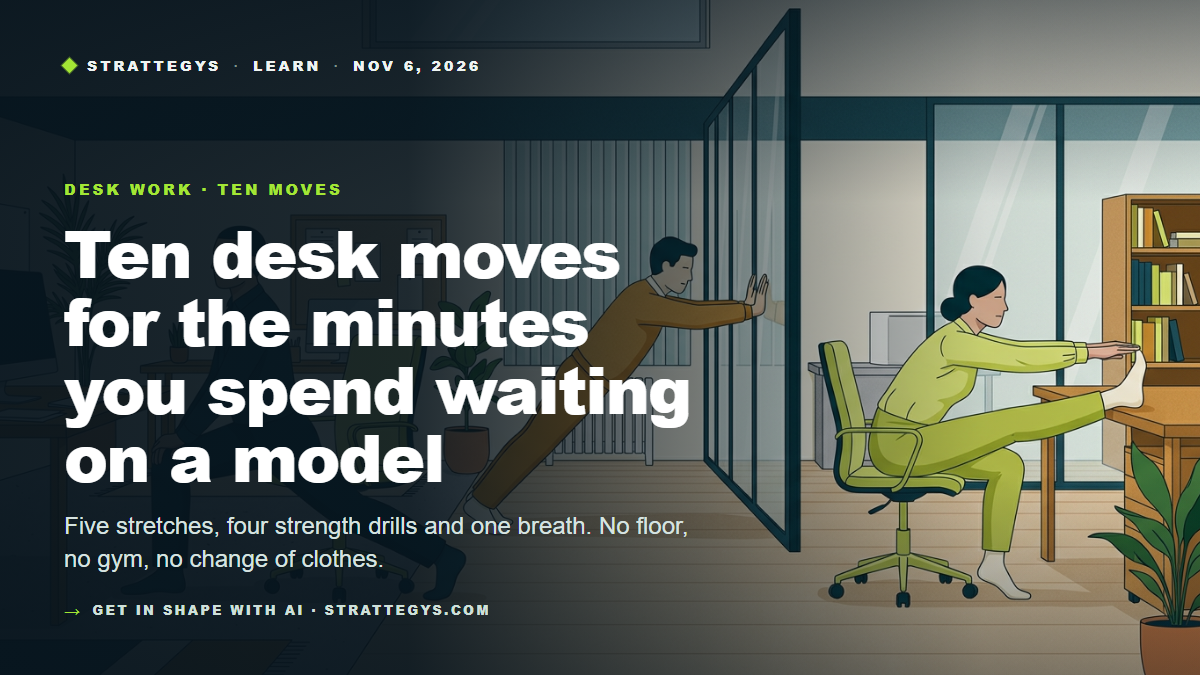
The spinner is the most reliable break in your day. Here is what to do with it: five stretches, four strength drills and one breath, none of which need a floor, a gym or a change of clothes.
You press enter.
Then you wait. Ten seconds, forty, sometimes four minutes while an agent works through a job. That wait is the only part of the day nobody has claimed. No meeting, no notification, no expectation that you are producing anything.
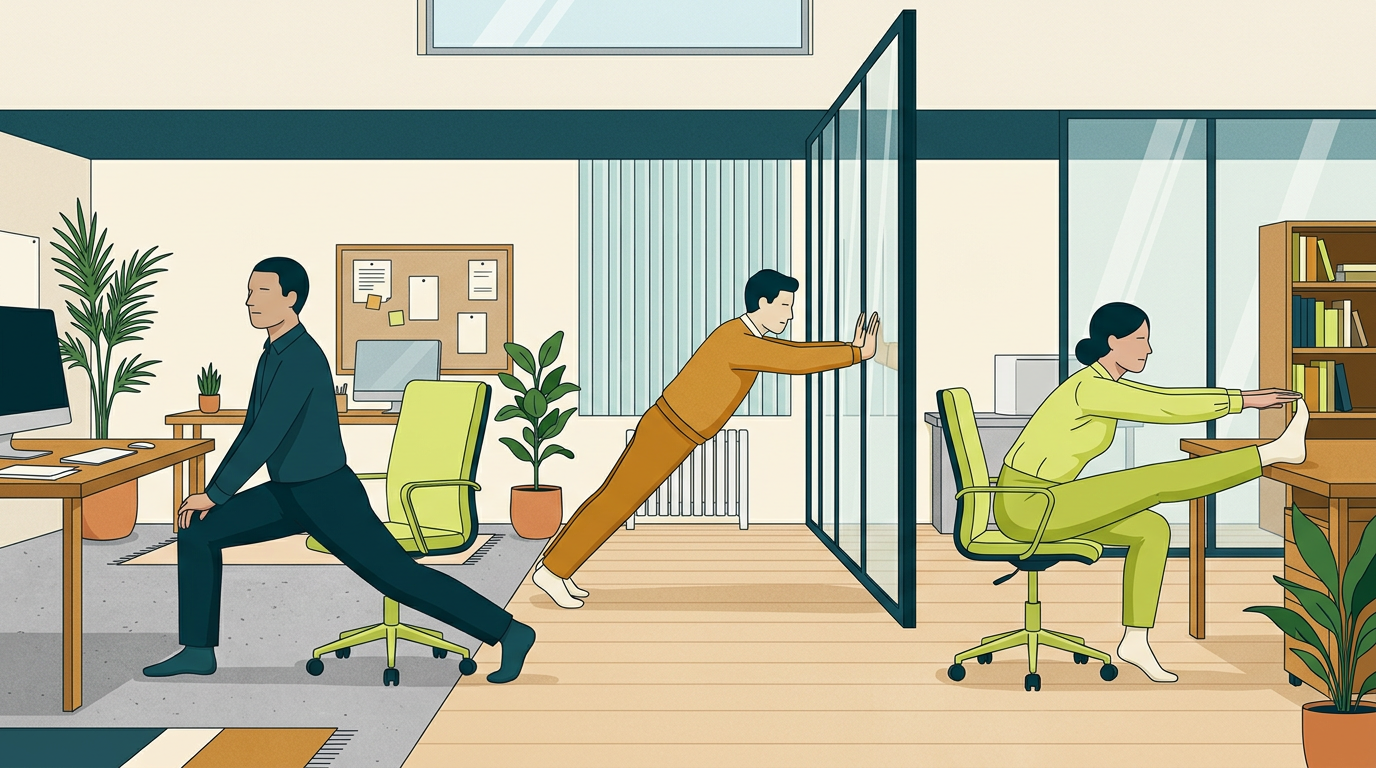
The spinner is the most reliable break in your day.
Ten moves for the minutes you already spend waiting.Most of us spend it sitting still, half-reading a second tab we will have to come back to. Waiting is not going away. The more work you hand to a model, the more of your day is spent between the prompt and the answer. The question is whether that time leaves you stiffer or stronger.
This is a set of ten moves built for that gap. Five stretches, four strength drills and one breath. Most fit inside a single wait. Three of them, done once each, are enough to change how the day ends.
How to use it
Match the move to the wait. Under thirty seconds, do one set of the chin tuck, the twist or the breath. Between thirty seconds and three minutes, do one full move. Over three minutes, do the three-move stack: neck, then hips, then legs.
One move per wait is the whole program. Ten a day is not the goal. Three is.
Base breath
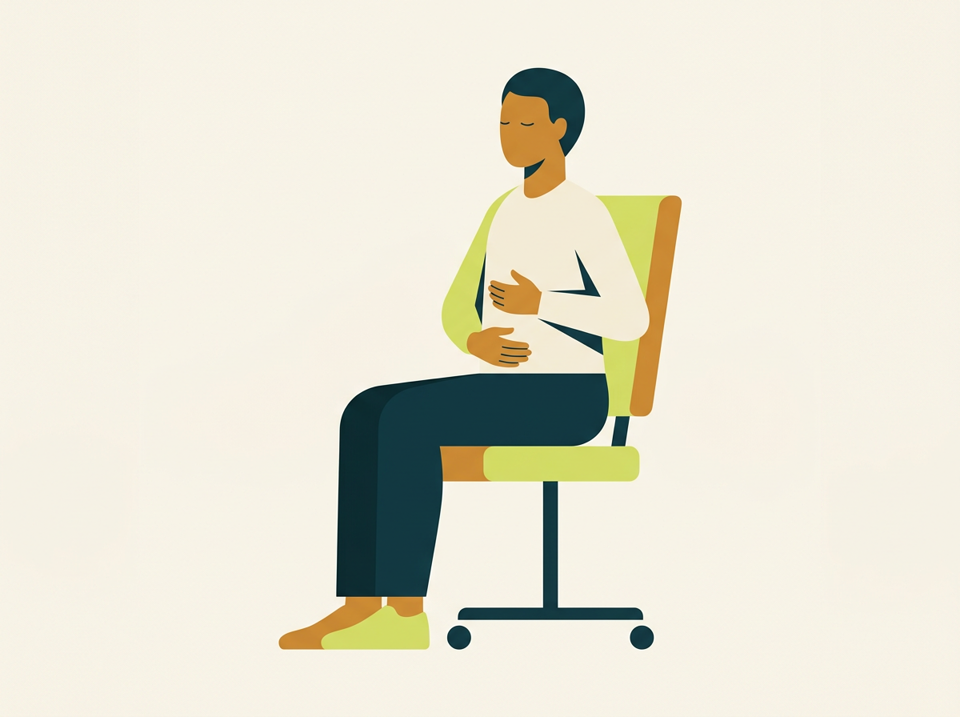
Before the stretching, the breathing. It sounds soft. It is the only move here that changes your state in under a minute, and it is the one that stops a wait from becoming another tab.
- Sit back in the chair. Feet flat. One hand on the ribs, one on the belly.
- Inhale through the nose for four slow counts and let the ribs widen.
- Exhale for six, longer than the inhale, and let the shoulders drop. Six breaths.
Dose 6 breaths, about 60 seconds. · Form check The belly moves, not the shoulders. If you feel lightheaded, shorten the inhale.
The long exhale is the part you control. It is also the part that lets the shoulders come down before you start moving.
Chin tuck
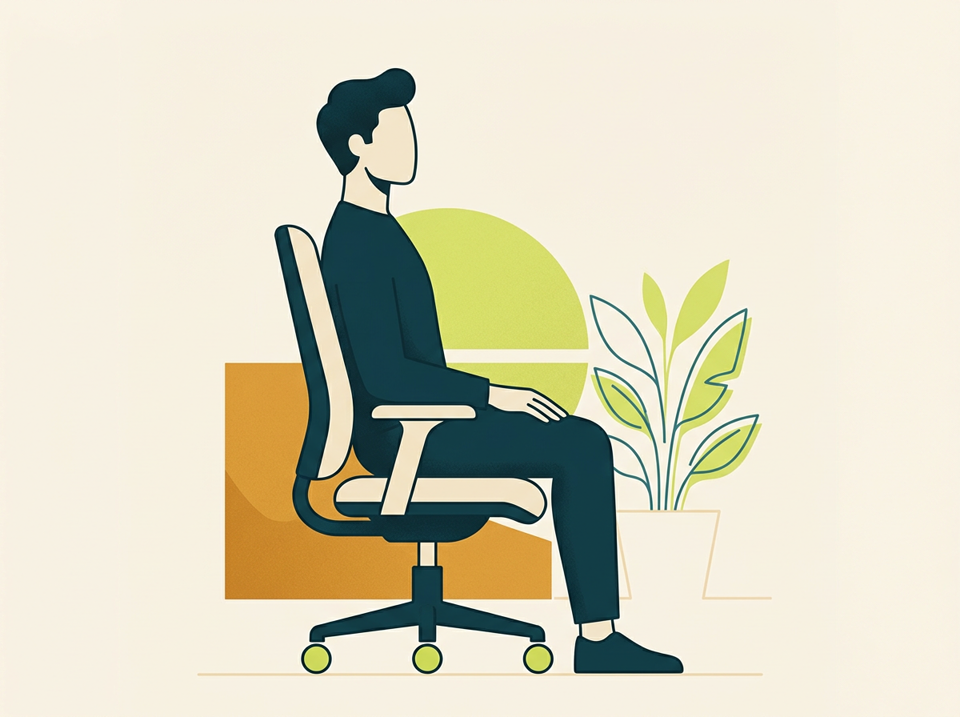
Your neck is not sore from work. It is sore from holding still. Ten weeks of two minutes of daily neck and shoulder training reduced pain and tenderness in office workers. This is the smallest honest version of that idea.
- Sit tall. Eyes level. Pick a point across the room.
- Without tilting, glide the head straight back until the ears sit over the shoulders.
- Hold five seconds. Release. Ten times.
Dose 10 reps of 5 seconds, about 90 seconds. · Form check It is a glide, not a nod. The range is about an inch. If it looks like a nod, it is wrong.
Small and frequent beats long and rare. Two minutes a day was the dose in the trial.
Doorway chest opener
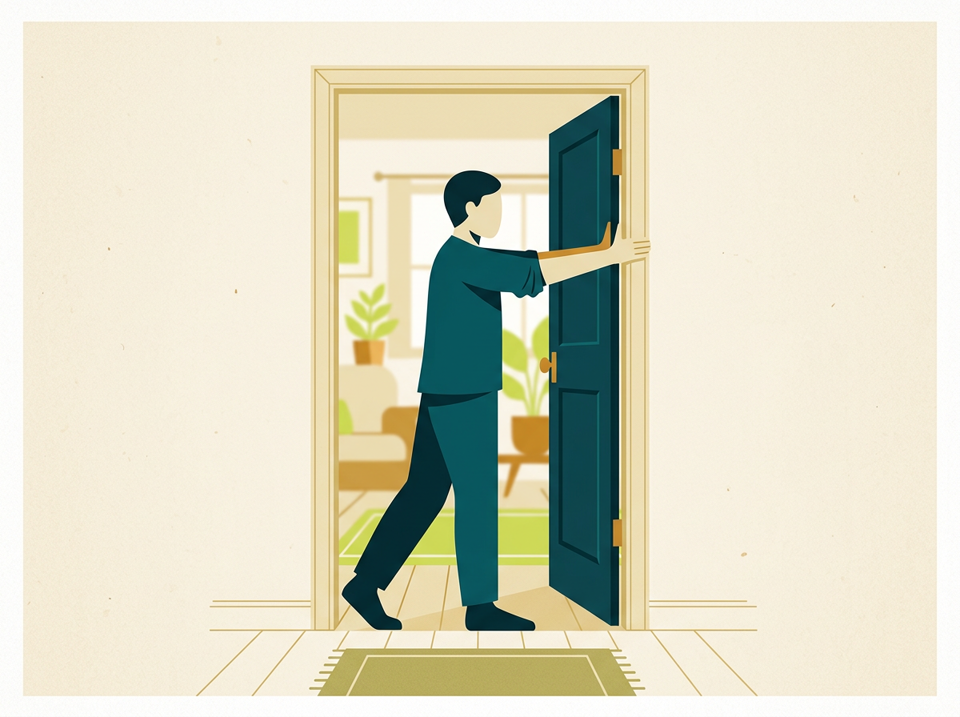
You have been folded shut since your first meeting. The chest shortens quietly, and then every overhead reach feels like a negotiation.
- Find a door frame. Put both forearms on it, elbows at shoulder height.
- Step the front foot through until you feel a stretch across the chest.
- Hold 30 seconds. Breathe. Change sides. Two rounds.
Dose 30 seconds a side, two rounds, about 2 minutes. · Form check Ribs stay down. If the low back arches, you are borrowing range you do not have.
A stretcher, not a fix. It buys the range you will load in the wall angel and the row.
Wall angel
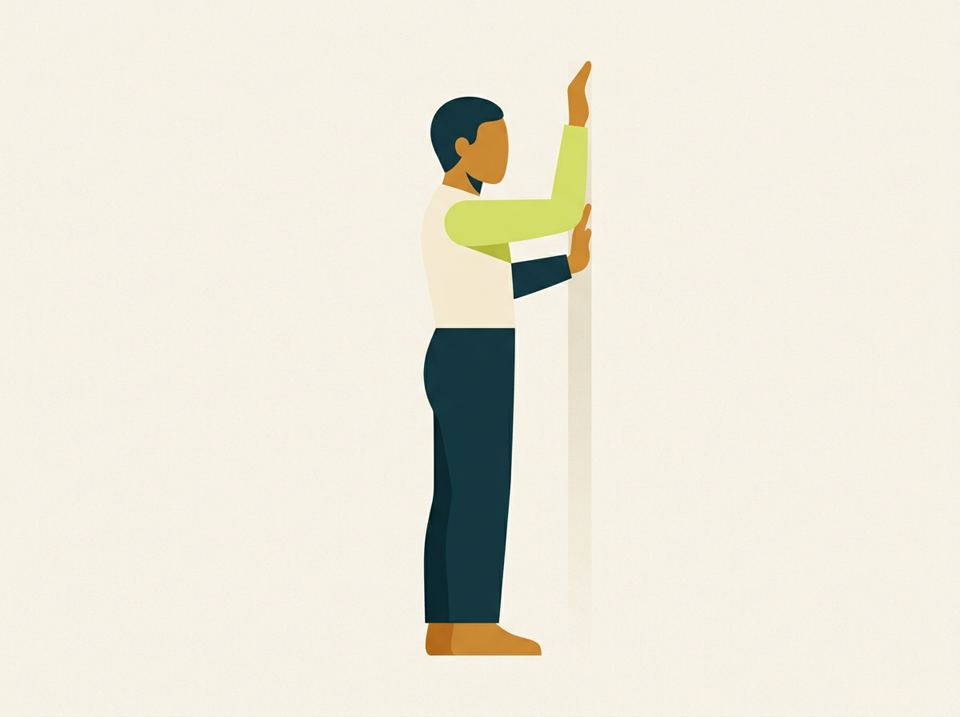
Your shoulder blades have not moved since 9am. Scapular control is the strength half of the neck and shoulder evidence, and the wall is the feedback a doorway cannot give you.
- Back and head against a wall. Feet a step out. Low back gently flat.
- Start with arms in a goalpost, elbows and wrists touching the wall.
- Slide them up as far as you can keep contact. Eight slow reps.
Dose 8 slow reps, about 90 seconds. · Form check Contact beats height. If the ribs flare or the back arches, shorten the range.
The wall tells you when you cheat. Cheating is how most people do this one.
Seated thoracic twist
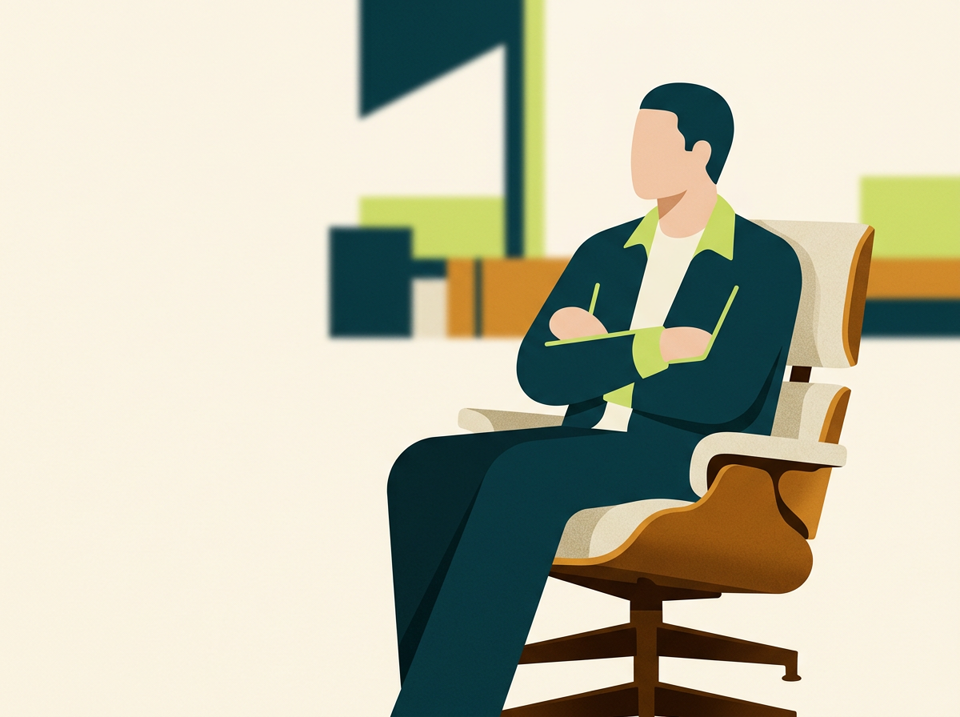
Sitting does not just stiffen your back. It deletes a direction. Rotation is the range you lose first when you sit still, and the range you need to look over your shoulder without moving the low back.
- Sit forward on the chair. Feet planted. Arms crossed over the chest.
- Rotate the ribcage to one side and keep the hips square.
- Let the eyes follow. Hold two seconds. Eight per side.
Dose 8 per side, about 90 seconds. · Form check Move the ribs, not the elbows. If the chair back blocks you, sit forward.
If you lead a team, watch how many of them turn their whole body to answer you.
Hip flexor lunge
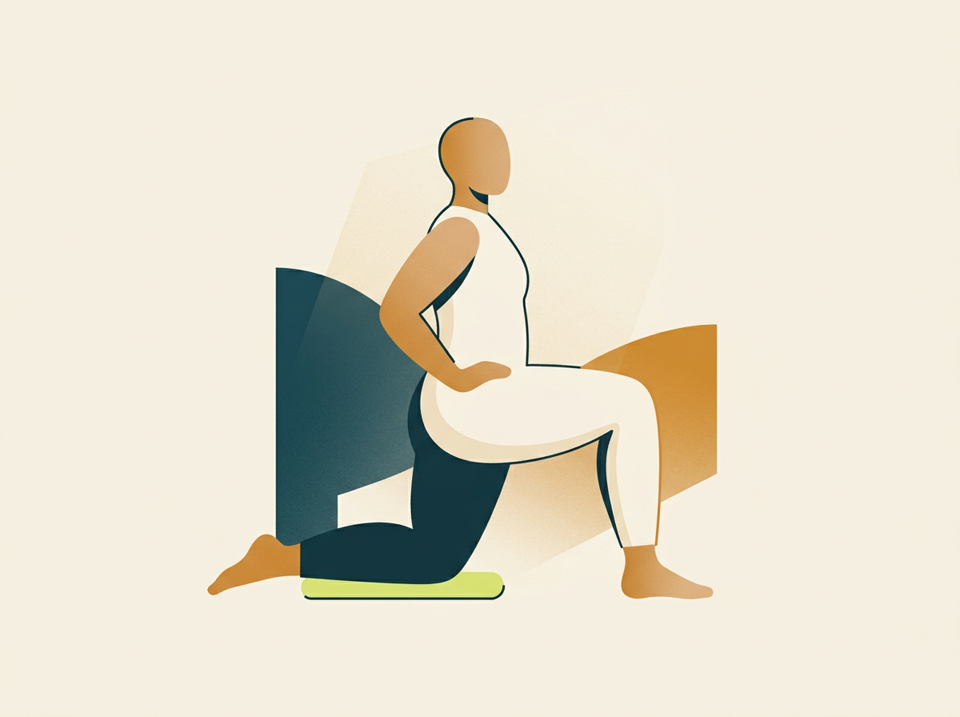
The muscle that hates your chair most is at the front of your hip. Hip flexor stretching reliably increases short-term range. Long-term posture change is unproven, which is why this is paired with the sit-to-stand.
- Half-kneel on a pad or a folded jacket. One foot forward. Both knees at right angles.
- Tuck the pelvis under and stand tall.
- Shift the hips forward an inch until the front of the rear hip lengthens. Hold 30 seconds. Change sides.
Dose 30 seconds a side, about 2 minutes. · Form check If you feel it in the low back, you are arching, not stretching. Tuck first.
Tuck, then shift. In that order. The order is the whole move.
Chair sit-to-stand
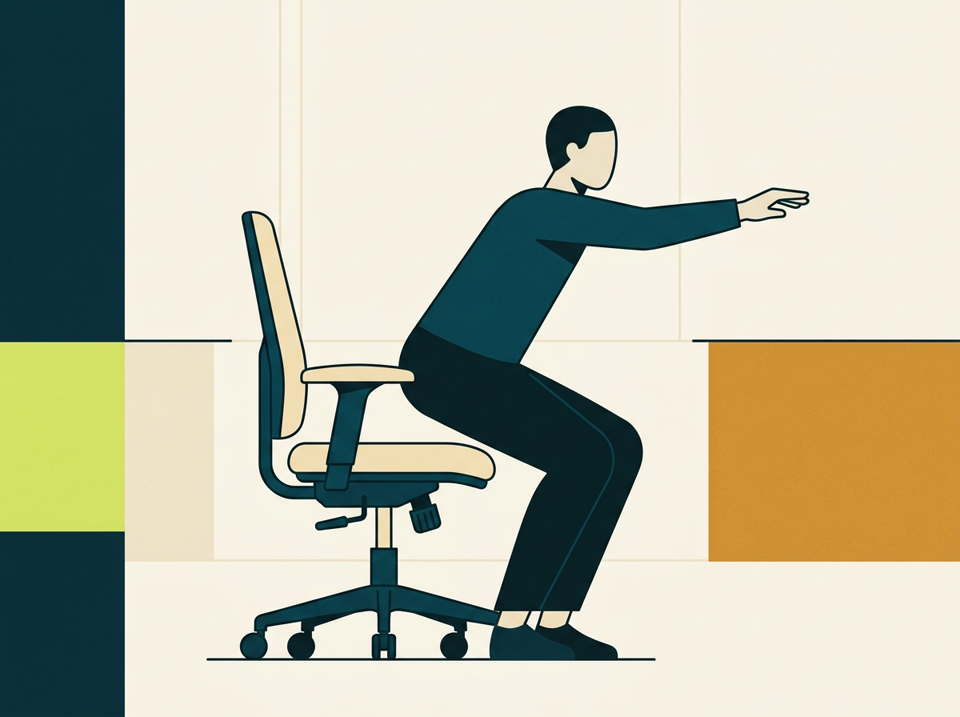
The legs do nothing for eight hours and then have to carry you down a flight of stairs. The sit-to-stand is a validated field test of lower-body strength, which makes it a score you can keep.
- Chair against a wall. Feet hip-width. Toes slightly out.
- Stand without using your hands. Squeeze the glutes at the top.
- Sit back down slowly until you touch the seat, then stand again. Ten reps.
Dose 10 reps, about 90 seconds. · Form check Knees track over the middle toes. Push the floor away. Do not pull yourself up with your neck.
Test it on day one and day twenty-eight. If ten is easy, slow the descent to three seconds.
Wall push-up
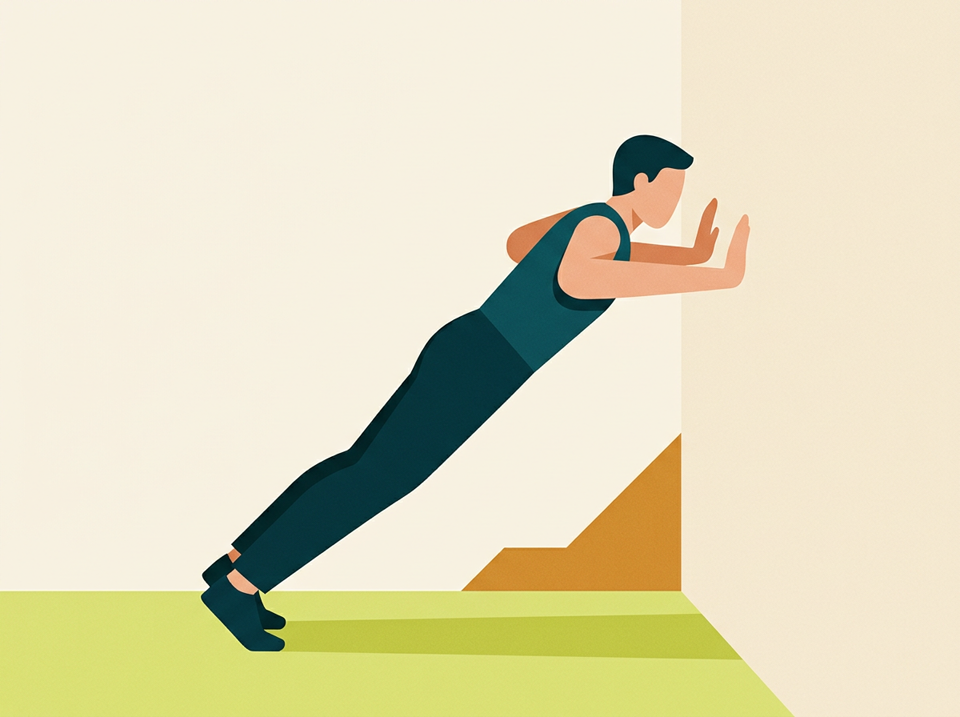
You do not need a floor to get stronger. You need a wall. Push strength is cheap to keep and expensive to rebuild, and the wall lets you train it in work clothes.
- Palms on the wall at shoulder height. One step back. Body in one line.
- Bend the elbows and bring the chest to the wall.
- Push away until the arms are straight. Ten to twelve reps. Step further back to make it harder.
Dose 10 to 12 reps, one or two sets. · Form check Ribs down, glutes on, no sagging hips. Elbows go back at about 45 degrees.
Feet further back is the whole progression. No equipment needed.
Soleus push-up
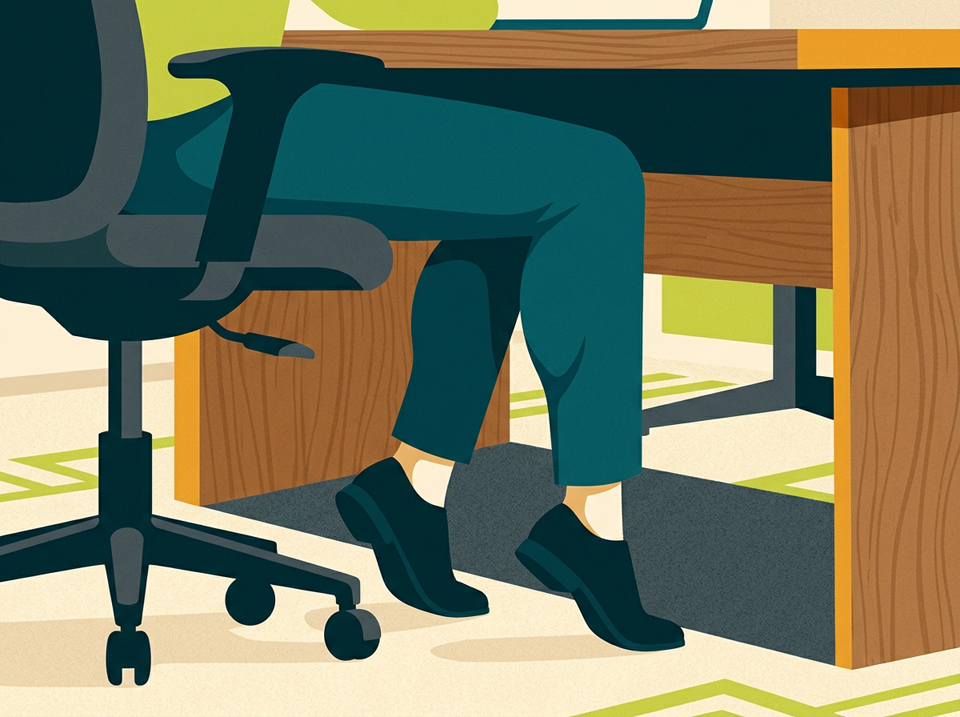
In a 2022 lab study, four and a half hours of seated soleus contractions cut post-meal glucose and insulin response by 52 to 60%. Two minutes is not four and a half hours. It is the version you will actually do.
- Sit with the feet flat, knees at 90 degrees.
- Keep the toes down and lift both heels as high as they go.
- Lower slowly. Stay in a small, continuous range. Two minutes, or the length of the wait.
Dose 2 minutes, longer if the model is slow. · Form check The balls of the feet stay down. You should feel the calf working, not the toes gripping.
This is the one for a long agent run. Small range, no bounce.
Towel row
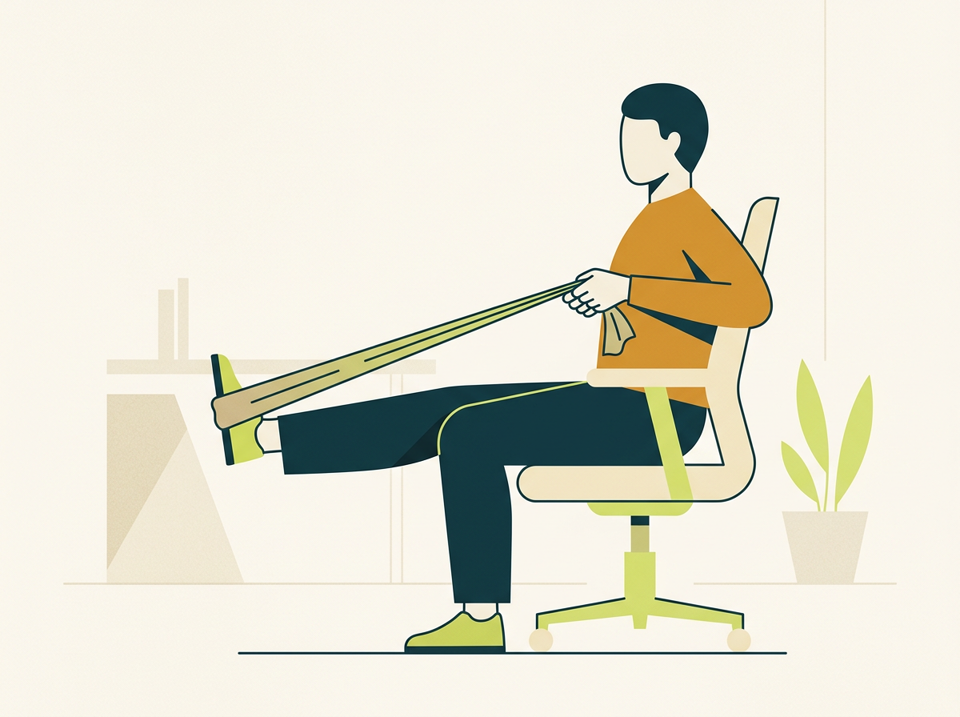
The keyboard pulls you forward. This pulls you back. Rowing loads the mid-back in the direction sitting unloads it, and the towel is the resistance you already have.
- Sit tall. Loop a towel around one foot. Hold an end in each hand.
- Pull the towel toward the ribs and drive the elbows back.
- Squeeze the shoulder blades for a second. Twelve slow reps.
Dose 12 reps, about 60 seconds. · Form check Shoulders stay away from the ears. The return is slow, not a drop.
Slow on the way back. That is where the work is.
The long wait: a twenty-minute circuit
Sometimes the model takes twenty minutes. That is a workout, not a wait, and it does not need to feel like one.
Round one — about 8 minutes
- Base breath — 1:00
- Chin tuck — 1:00
- Chest opener — 2:00
- Wall angel — 1:30
- Seated twist — 1:30
Round two — about 8 minutes
- Hip flexor lunge — 2:00
- Sit-to-stand — 1:30
- Wall push-up — 2:00
- Soleus push-up — 2:00
- Towel row — 1:00
Sixteen minutes of movement, four minutes of moving between them. Set the timer to the wait, not the other way round.
The five-minute version. Sit-to-stand, ten reps. Wall push-up, ten reps. Soleus push-up, two minutes. That is the whole body in one prompt.
The desk is the other half
Six adjustments, in order of payoff.
| # | Adjustment | Why |
|---|---|---|
| 1 | Screen top at eye level | The top third sits at eye height, so your eyes drop slightly and your chin does not. |
| 2 | An arm’s length away | You can touch the screen with a straight arm without leaning in. |
| 3 | Elbows at 90–100 degrees | Forearms supported, shoulders relaxed rather than shrugged. |
| 4 | Feet flat, knees at 90–100 | If your feet do not reach, use a box. A stack of paperbacks is a box. |
| 5 | Hips slightly higher than the knees | The setting most chairs get wrong out of the box. |
| 6 | Phone at eye level | The lap is where necks go to die. |
Eyes. Every twenty minutes, look at something twenty feet away for twenty seconds. The numbers are a rule of thumb, not a proven optimum. The part that matters is the break and the distance.
Wrists, between moves. Palms on the desk edge, fingers back toward you, thirty seconds each side. Then spread the fingers wide and make a fist, ten times.
What the evidence actually says
Neck and shoulder work has the best case. A 2026 systematic review of nineteen randomised trials and 2,732 sedentary workers found micro-exercises reduced neck pain with a large effect (g = -1.36) and combined neck and shoulder pain with a moderate-to-large effect (g = -0.79). Certainty was moderate for combined pain and low for neck pain: the trials were heterogeneous and showed signs of publication bias. Worth doing, not a cure, and probably smaller than the headline number. Read the review.
Two minutes a day is enough to matter. In a 2011 trial, two minutes of daily progressive resistance training for ten weeks produced clinically relevant reductions in neck and shoulder pain and tenderness in office workers. Read the trial.
Breaking up sitting works on the metabolic side. Two-minute light walks every twenty minutes lowered post-meal glucose by about 24% and insulin by about 23% in overweight adults. Read the study.
The soleus number is real but this is not that dose. Four and a half hours of seated calf contractions cut glucose and insulin response by 52–60% in a lab. Two minutes is a different thing. It is here because it is the only strength move you can do without leaving the chair. Read the paper.
Five of the ten moves are standard practice, not trial-proven. The chest opener, thoracic twist, wall angel, wall push-up and towel row are here because they load what sitting leaves alone. No trial shows they fix posture. They are low-risk, they feel good, and they make the other five easier to do.
References
- Yaghoubitajani Z, et al. Effectiveness of micro-exercises for managing neck/shoulder pain in sedentary workers: a systematic review and meta-analysis. Scientific Reports. 2026;16:27291. nature.com
- Andersen LL, et al. Effectiveness of small daily amounts of progressive resistance training for frequent neck/shoulder pain: randomised controlled trial. Pain. 2011. pubmed.ncbi.nlm.nih.gov
- Hamilton MT, et al. A potent physiological method to magnify and sustain soleus oxidative metabolism improves glucose and lipid regulation. iScience. 2022;25:104869. cell.com
- Dunstan DW, et al. Breaking up prolonged sitting reduces postprandial glucose and insulin responses. Diabetes Care. 2012;35(5):976–983. pubmed.ncbi.nlm.nih.gov
- Gibala MJ, et al. Do stair climbing exercise snacks improve cardiorespiratory fitness? Applied Physiology, Nutrition, and Metabolism. 2019. cdnsciencepub.com
- Konrad A, et al. The influence of stretching the hip flexor muscles on performance parameters: a systematic review with meta-analysis. International Journal of Environmental Research and Public Health. 2021;18(4):1936. mdpi.com
- Interventions for the management of computer vision syndrome: a systematic review and meta-analysis. Ophthalmology. 2022. aaojournal.org
Further readingWhy the wait is getting longer: what an agent actually is, what it does between the prompt and the answer, and the test that separates autonomy from marketing.
Read: What is an agent, really? →Get the next field note
New articles, show notes, and practical lessons from the Strattegys AI crew.
 Featured
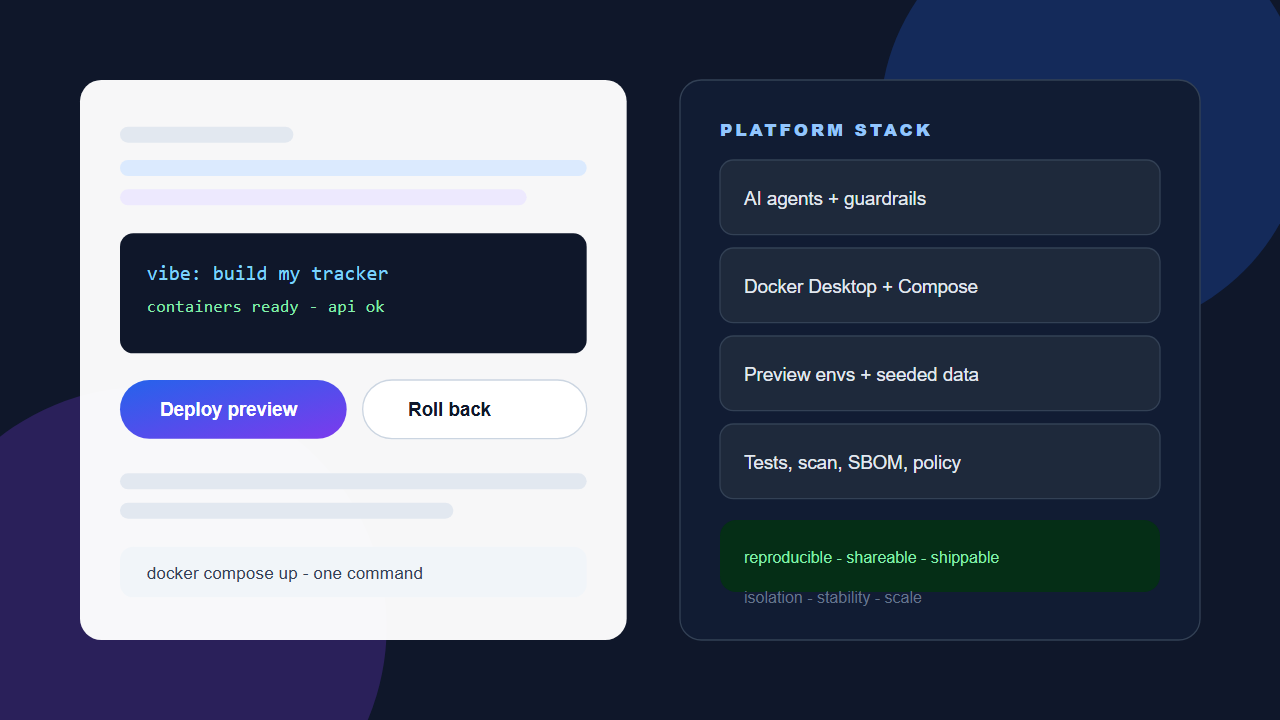
Vibe Coding Needs a Platform
Vibe coding is magic until it's time to ship. Docker Desktop is the platform that turns AI-built sketches into isolated, reproducible, shippable software.
 Spotlight
The Voice Layer Behind Real AI Production Work
The overlooked input layer behind serious high-volume AI production work: moving intent by voice through Aqua and Wispr Flow instead of typing.
 Featured
What Is an Agent, Really?
The word is everywhere; the meaning is not. A map of the agent economy, the web's second audience, and the test that separates autonomy from marketing.

LandingRabbit
A website that matches what you sell — built from your ideas, slide decks, and sales notes.
Visit site →Your brand here
Get your founding sponsor spot now.
Become a founding sponsor
Inquire to learn about features, shows, and sponsor placements. No plans, no pricing sheets — just a conversation about fit.