What Is an Agent, Really?
Everybody says they have one. Nobody means the same thing. A practical map of what builders mean, what enterprises buy, and the test that separates an agent from a chatbot with better marketing.

Everybody says they have an AI agent.
Nobody means the same thing.Open any feed and the word is everywhere. Agents write code, triage inboxes, book travel and run support — and the claims arrive faster than the demos.
This piece gives you a shared map: what builders mean, what enterprises buy, what the web is becoming, and a test you can run on any demo before you believe the noun.
The 30-second version
Autonomy is a claim. Verification is the test.
- 1AI today is 90% human-led assistant plus automation. True autonomy is still the exception, not the product.
- 2Money already votes: Menlo counts $177B in deployment, agents at 80% of tokens and 37x growth.
- 3Spend concentrates where work verifies — coding, support playbooks, checkable outcomes. Not open-ended promises.
The question nobody answers
Everybody started saying, oh, it’s an agent. I have an agent, and my agent does this. My agent does that. Then comes the pause that should embarrass the industry more than it does:
- “What is this agent thing you’re talking about, actually?”
- “What is it that you built?”
- “What is it that you’re calling an agent?”
People are not lying; they are labeling different machinery with one glamorous noun. Three different things get the same label:
- A chat widget that calls a model and reads a help center.
- A scheduled job that calls a model and triages a queue.
- A looping session that calls tools, keeps memory and asks for confirmation.
Only one resembles the science-fiction promise, and even that one usually works because a human scoped it tightly. This piece does not pretend to end the argument. It gives you a shared map: what builders mean, what enterprises buy, what the web is becoming, and a practical test you can run on any demo.
The throughline from months of building is uncomfortable but clarifying. The technology behind most agents is basic. The value comes from purpose, environment and verification, not from declaring autonomy.
“What is this agent thing you’re talking about, actually?”
From beings to super-apps
Around the turn of the year the personal agent felt like the breakthrough that would make AI the next big thing. The mental model was a digital being, another worker thinking and doing, a personal robot.
OpenClaw embodied that promise and proved unwieldy for daily work. The move to NanoClaw produced the deflating insight that still organizes this week: there is not much mystery in the mechanism.
Take a small server, put an API on it that makes language-model calls, add a few capabilities, run a cron job every fifteen minutes as a heartbeat, and you have roughly what the market calls an agent. Months went into treating those servers as individuals with purposes:
- One for development.
- One for operations.
- One for content.
- One for money.
Each had its own process, its own rails to talk to the others, its own memory toggle, its own status lights. It looked beautiful in screenshots. It did not produce proportional output.
The failure mode was coordination. Content needed execution rights it did not have. Execution needed development changes. Development needed contract updates. Every new power multiplied maintenance. Memory was switched on and rarely used well. Time went to keeping the beings alive instead of shipping work.
The pivot was to abandon autonomous beings and vibe-code super-applications that extend the business: a messaging system with embedded analysis, a CRM-like surface where AI drafts and scores, a content studio where topics carry memory and harnesses expose tools.
Results improved immediately because scope shrank to verifiable jobs. Ghost today reflects that settlement: topics scope the context that acts as memory, categories roll it up, isolated coding agents handle bounded tasks, and the human stays in the lead.
The avatar future may still arrive — persistent identities with addresses, rails for money and signatures, entities that transact. The companies chasing it are real. But the use cases that pay this year are narrower: assistants that extend a worker, automations that run on schedules, and agent-like loops only where outcomes can be checked.
If you cannot say what done looks like, you do not have an agent problem. You have a scoping problem.
“It’s like a personal robot… Digital robot.”
What the big sources actually agree on
Strip slogans and the serious definitions converge to one sentence: an agent is an autonomous system that perceives, reasons and plans, uses tools, and acts toward goals on behalf of a user.
- IBMAutonomously performs tasks for a user or another system.
- GooglePursues goals, reasons, plans, remembers and calls tools.
- NVIDIAComplex tasks from high-level goals inside secure environments.
- McKinseyTrillions in value; the shape is still to be determined.
- AWSAutomation follows rules; agents decide and adapt.
The disagreements that matter are not about that sentence. They are about thresholds and nouns. IBM splits the daily confusion: assistants await you, agents take initiative on specific work. AWS gives leaders the cleanest cut: automation stays fast and predictable, while agents operate with autonomy and adapt.
Practitioners fill in the texture. Reactive when asked versus proactive toward a goal. Drafts and answers versus executes multi-step workflows. Takes a task, decides the approach, breaks it into steps, touches systems. The indie version is the most useful discipline: an agent is a routine that earned enough trust to make decisions — so start at automation and promote on proof.
Critics keep the week honest. Some agents are chatbots with better marketing and fail a tool-integration test. The concept is overhyped outside software engineering and in regulated, security-heavy domains. Ambiguous success criteria make the noun meaningless: if done is undefined, autonomy is theater.
The index-card testIf done is undefined, autonomy is theater. Start at automation and promote only on proof.
No tools + no goal = not an agent.“The technology behind it is really basic.”
The web gains a second audience
In 2001 the Semantic Web asked publishers to tag pages so agents could book appointments against insurance and calendars. Tagging was labor with unclear benefit, so the human web won for two decades.
Large models removed the precondition. They read addresses and service lists without tags, interpret screenshots, click links and dropdowns, triage inboxes through connectors, shop for groceries, and buy through payment links without seeing card numbers while human confirmation gates spend.
- Read: pages, screenshots, service lists, inboxes.
- Decide: compare options, fill gaps, plan steps.
- Act: click, book, buy, submit — with a human gate where money moves.
Time now publishes agent-parseable versions and sells ads aimed at crawlers. Travel and commerce platforms expose agent interfaces. Two architectures compete: train computer-use agents to drive browsers like people, or expose back-end tools and let designers decide what agents may touch. The frontier just tilted toward the first.
The bridge we thought we had to build got crossed early. That creates a steering problem that cannot be solved with copy. To serve information to humans is now to serve it to agents, unless you block them and accept the cost.
Whether the human web survives is now a question of access design and delegation norms, not just model quality. Ask it directly this week: which parts of online life will you hand over, and where will you insist on human surfaces?
“I’m vibe coding super applications that are extending and enabling my business model.”
The money votes for verification
Menlo’s November 3 census makes the week concrete. Enterprise deployment reached $177B by September, up from $33B a year earlier — a 5.4x expansion adding more than $140B in new annual spend. Every dollar spent building models draws about $1.70 putting them to work.
Agents changed the accounting. They now account for roughly 80% of tokens on a major model router, about seven times human traffic, and grew 37x since February while human use grew 5x. When software works without people in the room, spend tracks work instead of headcount.
Critically, spend concentrates where verification is possible. Coding at $34B and chatbots at $25B together form 76% of a $77B app market because they provide environments to act, workflows to learn, and results to check. Customer success with playbooks grew more than 4x. HR and marketing, where judgment is subjective, grew far slower.

The bubble debate then resolves into something plainer. This is not a dot-com of worthless companies but an internet-like buildout hunting for hardware-burning uses. Something visual, consumer and ad-backed fills the gap. Dismiss the singing cats and you miss the economics.
“AI is 90% in the assistant — hyper-powering your assistant.”
What the week said
“Every dollar that went into developing models this year is generating $1.70 of revenue.”
“We thought we had to build a bridge to the AI agents, [but] the AI agents just were able to cross the bridge already.”
“It’s probably on par with getting a mobile phone.”
What kind are you building?
Score yourself
Score zero to two on four questions. The number is less important than the argument it starts.
| Dimension | 0 | 1 | 2 |
|---|---|---|---|
| Autonomy | waits for you | needs approval | proceeds alone |
| Tools & code | none | fixed set | picks and chains, incl. scripts |
| Memory | none | session only | persistent, with evals |
| Guardrails | neither | one | secrets hidden + human confirms external |
Then run the Stripe test from the scrum: the model never sees secrets, and a human confirms money or external action. Coding sessions and support playbooks pass. An open-ended mandate to go make money does not. The point is not to win the noun; it is to buy only the autonomy you can verify.
Human in the lead
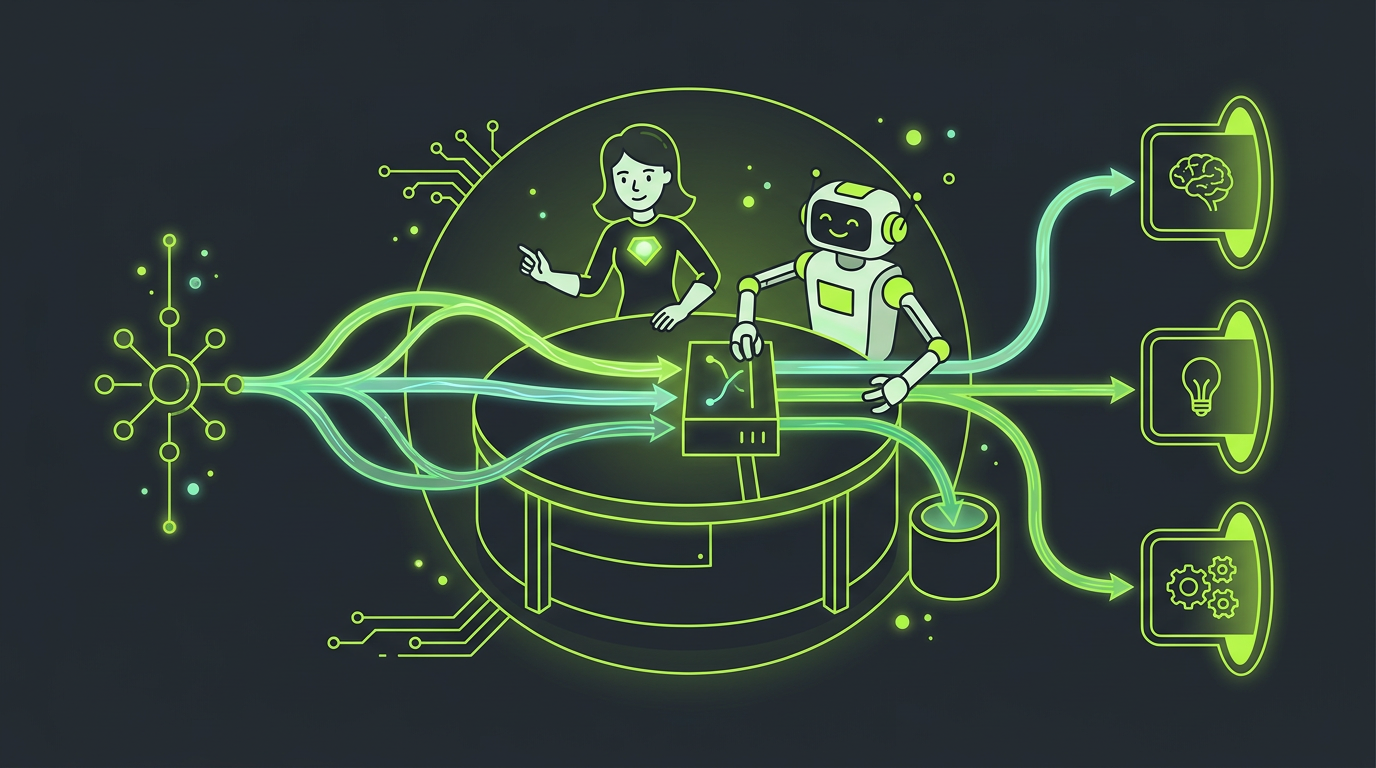
The workable pattern for most teams is unglamorous. Keep the human in the lead and let AI extend reach.
- Write scheduled jobs that do real chores.
- Put inference inside to triage queues, draft messages and prepare review packets.
- Embed your own language and context so drafts sound like you and respect the purpose of each thread.
- Reserve heartbeat autonomy for narrow domains with clear done states and full logging.
Heartbeat-style autonomy — surveying the environment every few minutes and choosing work — feels dangerous for good reason: cost, side effects and silent drift compound when no one watches. Use it where a result can be checked and every action is logged.
The question that closes the week is practical, not philosophical. Look at your own calendar and systems and name one job where verification is cheap and repetition is high. Start there. Instrument it. Promote it from assistant to automation to agent-candidate only when evals hold for weeks.
Definitions will keep fighting because incentives reward the bigger noun. Spending already tells you what to trust. Follow the verification, keep secrets from models, require human confirmation where money or the outside world moves, and let the word agent describe only the small set of loops that earn it.
Sources
Menlo Ventures, 2026 State of Enterprise AI (Nov 3) · MIT Technology Review, The agentic web is here (Nov 2) and Don’t let hype get ahead of reality (Jul 2025) · IBM, Google Cloud, NVIDIA, McKinsey, AWS, Domo, Sembly, OpenAI, Anthropic, HDSR/BCG · the Nov 3 morning scrum and its worker transcript.
This week’s newsThe 30 finds behind the argument — Menlo’s numbers, the agentic web, the critics and the builders, sorted.
Read the 30 finds →
Get the next field note
New articles, show notes, and practical lessons from the Strattegys AI crew.
 Learn
How to Train Your AI: The Employee Onboarding Framework for Autonomous Agents
Stop configuring AI like software and start onboarding it like an employee: why your next AI agent needs the same 90-day training plan as a new hire.
 Spotlight
AI Can Generate a Page. LandingRabbit Wants to Make It Usable.
A Strattegys Spotlight on LandingRabbit, the human edge of AI-enabled landing page building, and why the next useful layer is not generation but workflow.
 News
Man vs Machine — What the News Says
Thirty finds, niche first, big picture after: what the week's AI news actually says about jobs, skills, leverage, and the human edge.

LandingRabbit
A website that matches what you sell — built from your ideas, slide decks, and sales notes.
Visit site →Your brand here
Get your founding sponsor spot now.
Become a founding sponsor
Inquire to learn about features, shows, and sponsor placements. No plans, no pricing sheets — just a conversation about fit.