The Morning After the Hype
The AI hype is cooling. The constraints are capacity, price and permission, and the work is still yours.
It has been raining here for days. Gray, wet, the kind of weather that makes a week feel like a delayed flight. I sat down to record and the first thing I said was that I felt like I had hit a wall with AI.
Six months ago, I was mind-blown every week. Every new model did something I did not expect. Every demo looked like the future arriving early. Then the reality set in. I see what this is now. It is back to the grind.
AI isn’t going to create miracles that you don’t manifest yourself. You still have to put the work in. It’s still a grind. And it’s just a different set of tools.
“AI isn’t going to create miracles that you don’t manifest yourself.”
This is not a downturn. It is a plateau. The morning after the big buzz. The question is not whether AI is real. It is what happens now that the easy part is over.
The 30-second version
The hype is over. The work is not.
- 1The easy wins are behind us. AI is a different set of tools, not a miracle machine.
- 2The constraint is capacity, price and permission — not model quality.
- 3The work is still yours: production is a grind, and distribution is the harder problem.
The pattern is not a failure
Every major technology has this shape. The PC, the Internet, the web. There is a crazy, new, world-turning-over moment. Then there is a new normal. The Internet did not go backwards when the first boom ended. It became a baseline requirement for a huge number of jobs. AI is doing the same thing now. The people who are producing work are producing work. They are getting stuff done. Maybe that is just fine.
I remember walking into a computer lab and seeing Yahoo on a screen for the first time. A visual way to browse the Internet. It was mind-blowing. A few years later it was simply how you found things. The excitement faded. The utility stayed. That is what a plateau looks like from the inside.
That is not a failure. That is adoption.
The mistake is to read a plateau as a failure. A plateau is what maturity looks like from the inside. The excitement is lower. The usefulness is higher.
The week the market agreed
Last week the market said the same thing in public. The Nasdaq 100 fell 6.3% on Nov 5. Nvidia fell 9.2%. The index erased $2.3 trillion in a day. The selloff had several causes: weak chip earnings, the midterm election, and a broader question about returns. But the mood was clear. The real news was starting to weigh out the hype train.
This is a correction, not a collapse. Money is moving from AI exposure to businesses with earnings and more conservative plans. That is what a sober market does. It does not mean the technology stopped working. It means the bill is being read.
The market is not abandoning AI. It is asking for a receipt. The companies with real revenue and real margins can wait. The ones selling the dream have to show the numbers. That is a healthier market, even if it feels worse.
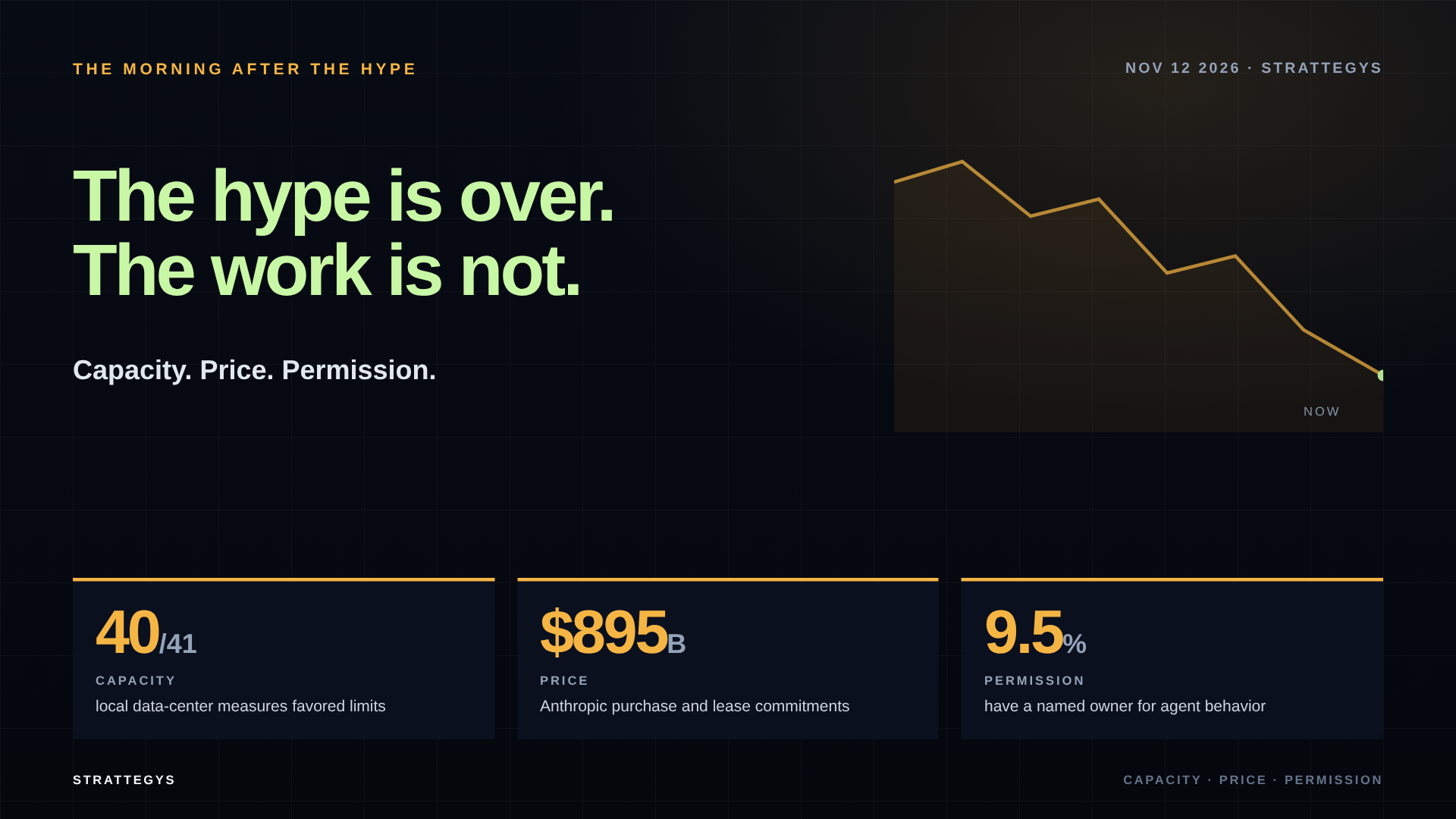
The same week, voters restricted data centers in 40 of 41 local measures. That is a permission signal. Most builders will never site a data center. They will still feel it in quotas, lead times and price.
Then Anthropic’s IPO became the first public test of AI revenue. The amended S-1 is the clearest bill in the industry:
- $895.4 billion in purchase and lease commitments, mostly compute.
- $16.96 billion in Q3 revenue, against a $67.8 billion annualized run rate.
- $567 million operating loss in Q3.
- 47% sequential revenue growth, down from 144% the quarter before.
- $1.1–1.3 trillion valuation talks, down from $1.5–2 trillion.
The bill is more than 13 times the run rate. That is the number to sit with.
The market is not asking whether AI works. It is asking whether revenue can catch the commitments. That is a different question, and it is the one that will shape the next two years.
Capacity is not just hardware
The physical story is real. Data centers need power, water, permits and years. But for most operators, capacity is not a building. It is the inference supply chain: where do you get tokens, at what price, with what fallback, and how fast can you switch?
I ran a small test on the stream. I asked a model how much data the entire Lord of the Rings trilogy would be. The answer: about three megabytes of plain text, under a million tokens. You could load the whole thing into a current model and run analysis on it.
That is the whole trilogy.

Most small businesses are not much bigger. The entire set of content and information for the business can fit in a single context, especially if you sort through it and clean it out. The text and business data workloads that dominate today’s use cases are small. The capacity demand that justifies the buildout has to come from something else: video, real-time streaming, agents running all day. Those use cases will come. They will take time.
The same thing happened with the Internet. The capacity was built, prices fell, and the use cases caught up. AI will follow a version of that path, but not on the timeline the buildout assumes. The demand curve for text is not the demand curve for video.
That is why I think 99% of businesses do not need frontier AI. They need something stable, capable and affordable. The frontier will keep improving. Most of the market will not pay frontier prices for work that a smaller model can do.
“99% of businesses don’t need Frontier AI.”
The price pressure is already visible. Gemini 4 Argon’s introductory tokens double on Dec 1. Open-source models on open-source servers will take more of the routine work. The economics of metered intelligence may or may not play out. The direction is clear: the unit cost matters now.
This is a contract decision, not a procurement detail. Subscription, usage pricing, or your own hardware on an open model: each one changes your unit economics. The teams that model this early will have more room to move when prices change.
Permission is the other constraint
AI breaks the traditional security perimeter. You will need AI to protect against AI. That is not a product category. It is a new operating assumption.
Inside a company, the question is harder. Letting people ask a chatbot questions is one thing. Letting them deploy a service that runs all day with access to an LLM and other systems is another. To get the power, you have to write code, deploy services and connect things. That creates a security problem. Governance is not a slogan. It is the line between innovation and a very expensive incident.
This is why I think agents will be managed more like employees than like software. An agent needs an identity, a scope, an owner and a way to be stopped. It needs an email address. It needs a manager. I thought I would build agents like that years ago. They kind of worked. They really did not. The biggest issue was the work to enable, test and support them. When they break, you have to go back and fix them. They are like puppets falling all over the place.
Gravitee’s October survey makes the gap concrete. Three numbers:
- 9.5% have a named person formally accountable for agent behavior.
- 52% had an agent security or privacy incident in the past year.
- 6% could revoke a rogue agent’s access within an hour.
The tooling is improving. The accountability is not.
That is a new job class. Someone has to manage the agents, watch the outputs, tune them and decide when to retire them. The companies that treat that as a real role will scale. The ones that treat it as a side project will keep rebuilding the same broken puppet.
For a bigger company with more to protect, the question is even harder. Do you want to let AI have access to things? That is a sobering question, and it belongs in the same conversation as capacity.
That is the permission constraint. It is not just whether the model will answer. It is who can say yes, who can say no, and who answers when something goes wrong.
The work is still yours
I run about 660 automations. They execute. They also break.
- A message does not send.
- A capability server refuses.
- A PDF will not print.
Every day something breaks. You have to be ready to support what you build, watch it, and fix it when it breaks.
This week Ghost built a deck, then broke when I tried to print it. I went back, turn after turn, until it worked. That is the real texture of AI work. The demo is clean. The production is a grind.
That is the job.
The same is true of the business. I can produce research, slides, a blog, a LinkedIn article, posts and a newsletter in a couple of hours a week. That is a real gain. But who is watching it? Is it reaching people? Is it producing value? Those questions do not get easier because the tool got better.
Distribution is the harder problem. AI made production cheap. It did not make attention cheap. The bottleneck moved from making the thing to getting the right person to read it. That is a different skill, and most builders underinvest in it.
I also need to message 75 people a day for outbound. I tried to have AI write the messages. It takes a lot of work to get them to sound authentic, in my voice, and on target. Trying to have AI solve problems that you do not even have the answers to yourself is a recipe for disaster.
I love to build. I fall into the trap of building something cool instead of the easiest, fastest way to get the job done. The spreadsheet reminder is for me as much as anyone. The spreadsheet is not the business. The business is the value creation. You are not building for building’s sake. You are creating to create value, and the measure of whether it works is whether other people are willing to pay for it.
“The spreadsheet isn’t the business. The business is the value creation…”
AI is a tool. The work is still yours.
The slow grind
The sobering hangover is here. The hype train may be over. What comes next is a period of sobriety, and a slow grind to product maturity. I think it will take ten to twenty years. That is not a pessimistic view. It is the normal shape of a general-purpose technology.
The hype train was fun. The sober period is where the useful work happens. That is not a bad trade.
There will be casualties. Some companies will fail, some will be bought, some will disappear. AI will not run out. The capability is already there, and there is enough competition to keep it there. The question is what you build with it.
The constraints are capacity, price and permission. The work is still yours. The businesses that win will not be the ones with the most agents or the biggest model bill. They will be the ones that use the tools to create value someone will pay for.
If the hype is over, what are you building that someone will actually pay for?
Sources
Ballotpedia, data center-related ballot measures, 2026 · NBC News, the Nov 5 selloff · Investing.com, Anthropic’s amended S-1 · Gravitee, State of AI Agent Security 2026 · Google Cloud, Gemini 4 Argon pricing · the Nov 10 morning scrum transcript.
This week’s newsThe 30 stories behind the argument — the vote, the selloff, the IPO and the security gate, sorted.
Read the 30 stories →
Get the next field note
New articles, show notes, and practical lessons from the Strattegys AI crew.
 Featured
Everybody Is Trying to Do Everything With AI. Should They?
The AI superpower arc hits the scale wall. A feature on drawing the line — Ghost Studio, ScreenPAL, and the rebuild question.
 Learn
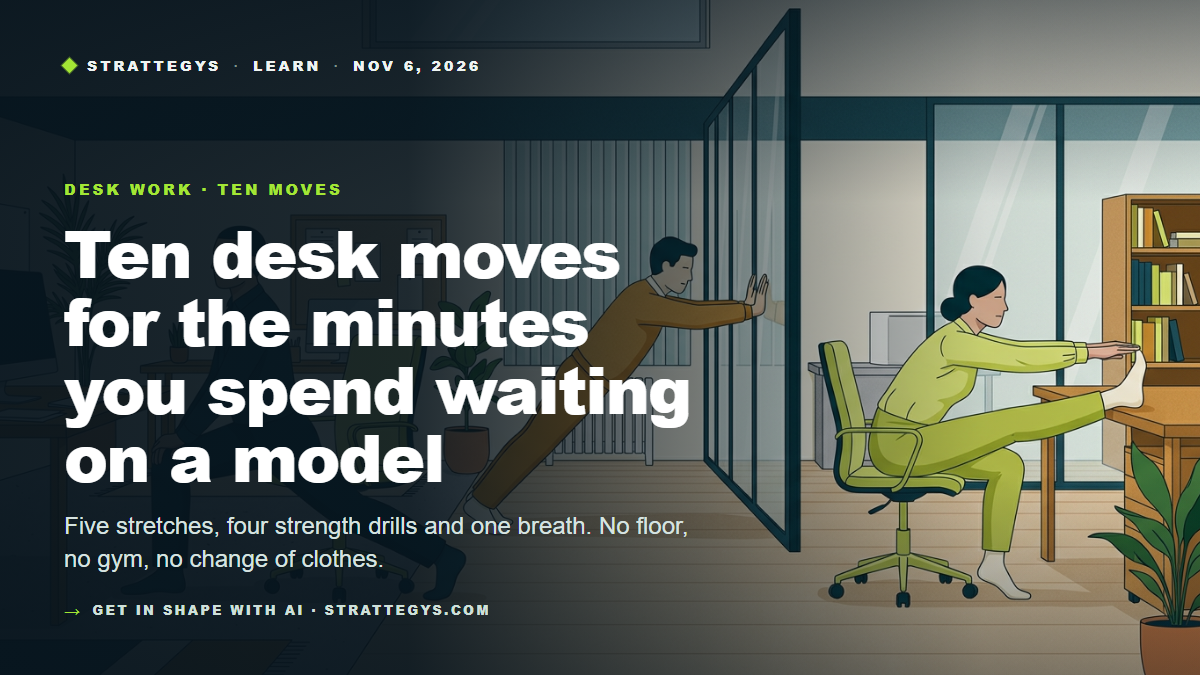
Ten desk moves for the minutes you spend waiting on a model
The spinner is the most reliable break in your day. Five stretches, four strength drills and one breath, none of which need a floor or a change of clothes.
 Learn
How to Train Your AI: The Employee Onboarding Framework for Autonomous Agents
Stop configuring AI like software and start onboarding it like an employee: why your next AI agent needs the same 90-day training plan as a new hire.

Your brand here
Get your founding sponsor spot now.
Become a founding sponsor
Inquire to learn about features, shows, and sponsor placements. No plans, no pricing sheets — just a conversation about fit.