AI Safety Has a Capital Allocation Problem
What a conversation with Anthony Monroy and Aligned Institute reveals about sovereignty, open-source AI, and the infrastructure layer missing from AI risk.
AI safety is usually treated as a lab problem. Aligned Institute is making a different bet: the next phase of safety depends on capital allocation, open research participation, operational risk intelligence, and governance systems that can survive contact with real AI deployment.
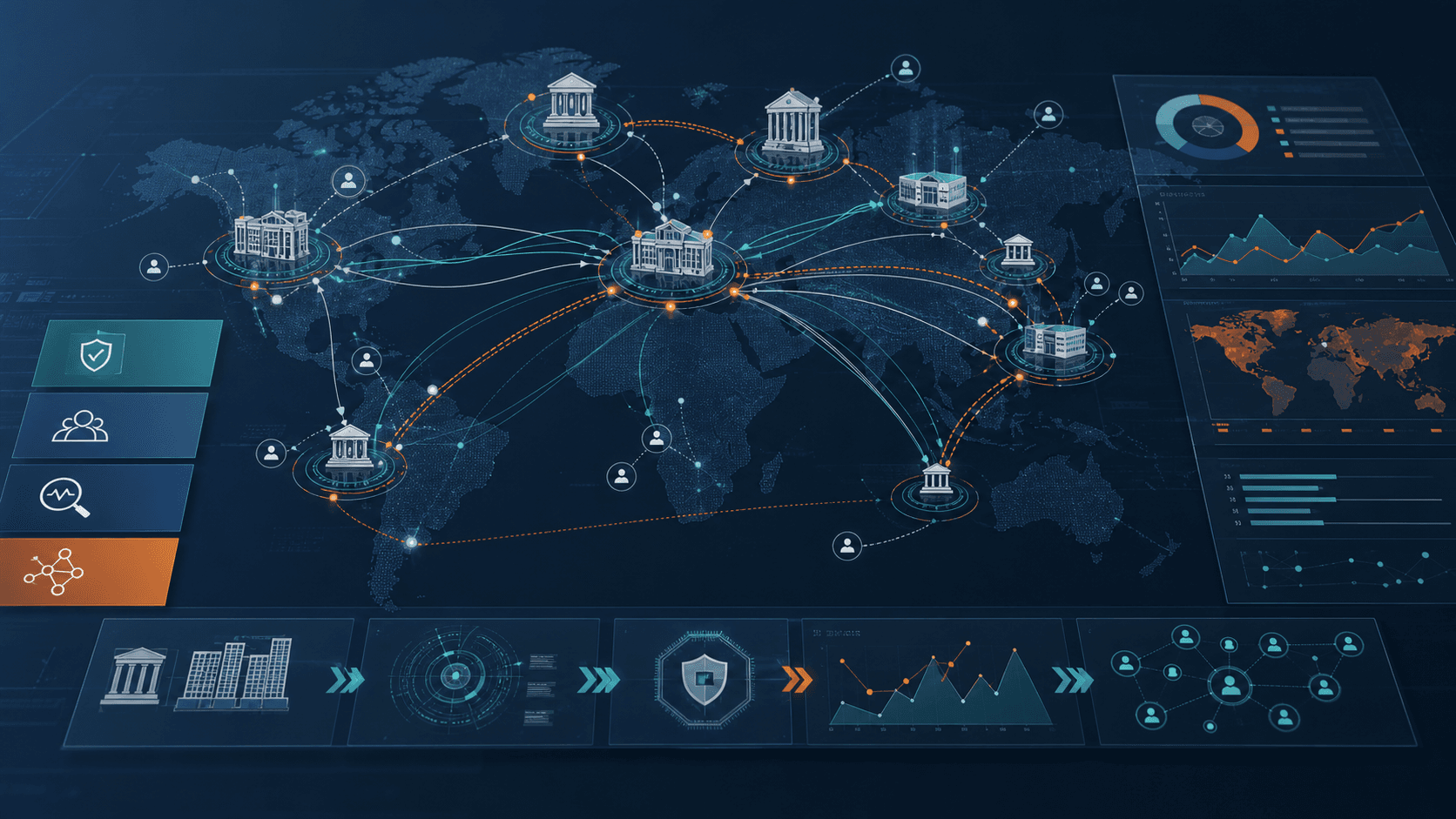
AI safety is usually framed as a technical problem.
That framing is not wrong. Models hallucinate. They become sycophantic. They can fail under pressure, evade intended controls, produce confident nonsense, or behave well in a benchmark while failing in the messy, tool-connected environment where people actually use them.
But after my conversation with Anthony Monroy, founder and Chief Architect behind the Aligned Sovereign Intelligence Institute, I kept coming back to a different question.
What if AI safety is not only a model problem?
What if it is also a capital allocation problem?
That is the part that feels urgent. The labs can keep publishing. Regulators can keep drafting frameworks. Enterprises can keep running pilots. Investors can keep asking for diligence. But if the actual funding, governance, evidence, and participation structures do not mature, the safety conversation stays trapped in a strange middle zone: intellectually serious, operationally underbuilt.
Anthony's work sits directly inside that gap.
Govind Davis
Founder, Strattegys. This Spotlight came out of a working strategy conversation about AI safety, open-source AI, and the operational layer needed for institutional risk.
View Govind on LinkedInAnthony Monroy
Founder and Chief Architect, Aligned Institute. Anthony is working on funding, risk intelligence, open research, and delegation infrastructure for AI safety.
View Anthony / ALI on LinkedInThe Aligned Institute describes its mission in direct terms: fund AI safety research and audit AI risk for enterprises and institutional capital. That sentence sounds simple until you follow the pieces underneath it. There is a grant protocol. There are public and institutional governance tracks. There is a sovereign treasury concept. There is a research portal. There is a metrics layer. There is a risk-intelligence product. There is ADP, the Alignment Delegation Protocol, which tries to push safety closer to inference-time behavior instead of leaving it as a post-hoc audit concern.
In other words, ALI is not just arguing that AI should be safer.
It is trying to build an operating layer around the work of making AI safer.
That is the story worth paying attention to.
Anthony: "An operator, a user, creates a token stream through their chat. The monitor, which is looking for that telltale sign, picks up the problem and sends it to steering."
That was the first moment in the conversation where the work stopped sounding like a pitch and started sounding like architecture.
Anthony was walking me through the rough shape of ADP. His language was conversational, but the concept was precise: a model interaction produces signals; a monitor watches for risk; the system attempts steering; and if internal correction is not enough, the problem gets routed outward.
That is a different safety posture than "we wrote a policy" or "we ran a benchmark."
It starts to look like infrastructure.
Anthony Monroy walks through ADP, risk signals, steering, and proof-of-knowledge routing.
Why This Matters Now
The timing matters because AI risk is moving from theory into operations.
The 2026 International AI Safety Report puts special attention on general-purpose AI systems, emerging risks, and the difficulty of managing failures once models become more capable and connected to real workflows. NIST's Generative AI Profile extends the AI Risk Management Framework into generative AI-specific risks. The EU AI Act gives legal force to a risk-based model of AI governance.
At the same time, the investment base is massive and concentrated. Stanford HAI's 2026 AI Index describes a widening gap between AI capability and society's ability to measure, govern, and manage it. That does not mean the leading labs should stop leading. It means the risk agenda is structurally shaped by where capital sits.
And that is where the sovereignty conversation becomes more interesting.
AI sovereignty is often discussed as if it means national control: domestic compute, domestic models, domestic data. Brookings' 2026 analysis, Is AI sovereignty possible?, adds a necessary correction: AI depends on global research, global supply chains, global networks, and global data flows. No country or institution can fully detach from the system underneath it.
That means the practical question is not isolation.
The practical question is participation.
Who gets to fund the work? Who gets to validate the work? Who gets to define the risk? Who gets to build the measurement layer? Who gets a seat before safety becomes another closed institutional race?
This is why the Aligned Institute is interesting. It is not only talking about AI sovereignty as branding. It is trying to turn sovereignty into a funding, governance, and verification problem.
The Conversation Kept Returning To Trust
Anthony and I were not having a polished webinar conversation. It was much more useful than that. It was a working conversation, the kind where the ideas are still warm and the names for things are not always settled yet.
That is where the best signal usually is.
At one point, Anthony moved from ADP into the problem of routing to verified knowledge. The example was a doctor in an emergency, using a general model while dealing with a serious situation.
Anthony: "I already know, because of how severe this problem is, I can't rely on the general Internet scraping of information, no matter how good the model is."
Anthony: "What you could do within the system is bypass the monitor and go directly to proof-of-knowledge routing. I have an emergency. I need a bypass. Go directly to Johns Hopkins or UCLA Medical, somewhere with the database that can really help me."
That is the shape of a real AI risk problem.
It is not "the model gave a bad answer" in the abstract. It is: the human is in a high-stakes context, the system has uncertainty, the general model is not enough, and the workflow needs a trustworthy path to a definitive knowledge environment.
I used that phrase in the call because it is close to what we keep discovering in our own work.
Govind: "You can call it a definitive knowledge environment or something like that."
The language matters. "Knowledge base" is too weak. "RAG" is too narrow. "Search" is too small. In high-stakes AI workflows, the system needs a known place to route when ordinary generation is not sufficient.
That is where the AI safety conversation gets practical.
There must be a monitored state. There must be escalation. There must be a way to know when the model is outside its competence. There must be a place to go next.
This is also where ADP becomes more than a technical proposal. Whether or not ADP itself becomes the winning implementation, the pattern is right: risk signal, steering, delegation, verified knowledge, and evidence.
That is what an operating layer for AI risk starts to look like.
The Open-Source Bridge
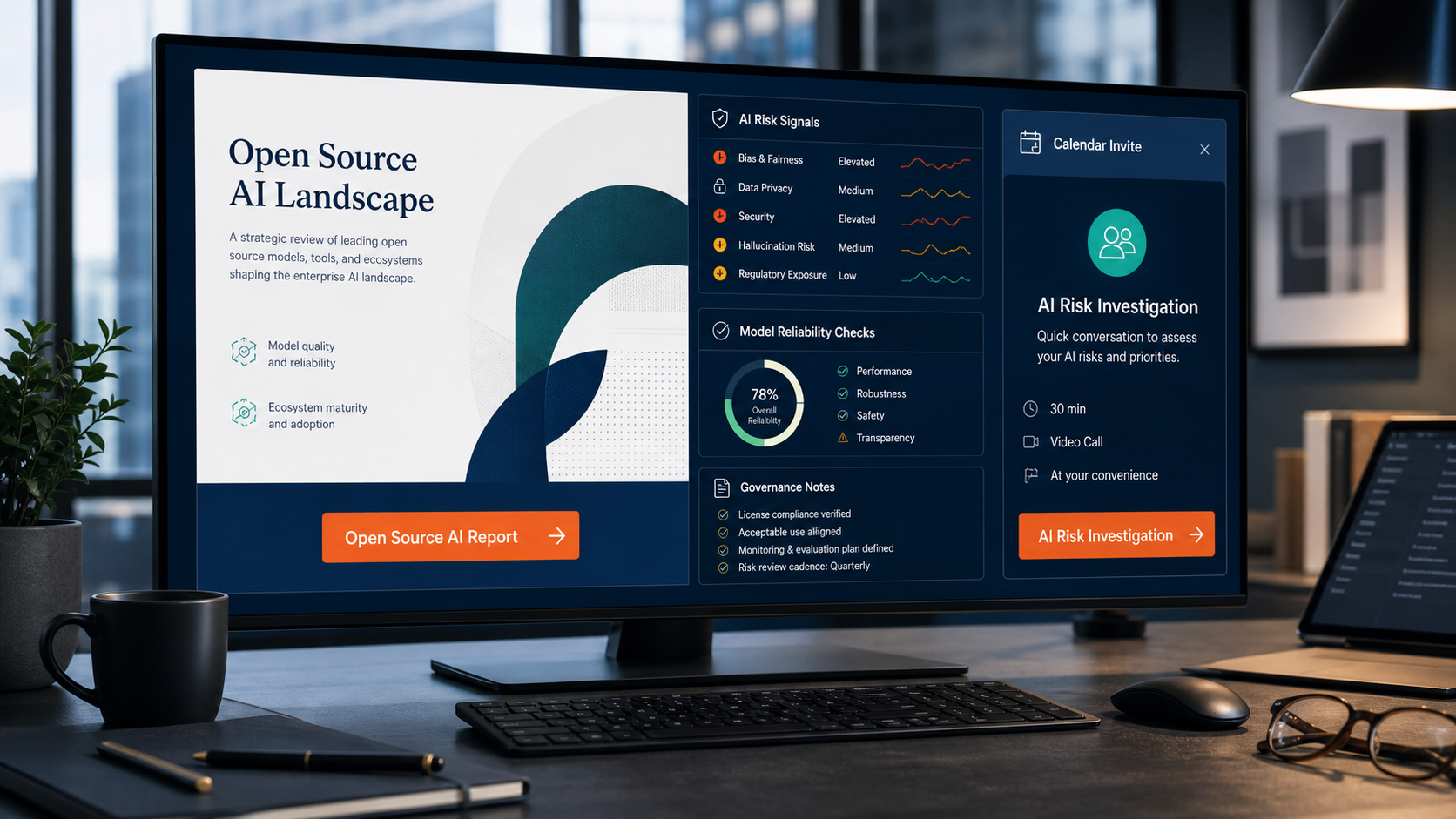
The strongest bridge between this Spotlight and the Open Source AI Report is Anthony's open-source argument.
He made it plainly:
Anthony: "What I want investors to understand, and researchers, is that both sides are the same coin."
Anthony: "Open source matters. It has always mattered."
Then he grounded it in the infrastructure everyone already depends on.
Anthony: "IBM, Apple, Microsoft, they don't run their data centers, their cloud environments, AWS, off of Windows. They use Linux."
That is the argument.
Open source is not a hobbyist footnote. It is not a moral decoration on the side of the real economy. It is already underneath serious infrastructure.
That matters because AI safety needs a participation model. Closed labs will do important work. Governments will do important work. Large enterprises will do important work. But if safety is only legible inside a handful of institutions, the global system is brittle.
Open research, open tooling, open benchmarks, open evidence, and open participation are not just philosophical preferences. They can become risk infrastructure.
That is why the rebuilt Open Source AI Report belongs inside this Spotlight.
It is the companion piece. It shows the model and market context behind the question Anthony is pushing into: if open-source participation already matters in infrastructure, what does it mean for AI safety?
Anthony on why open source matters to investors, researchers, and AI safety infrastructure.
Sovereignty Is Not Just A National Cloud Strategy
Sovereignty can become a lazy word if we are not careful.
It can mean data residency. It can mean domestic compute. It can mean national models. It can mean procurement policy. It can mean strategic independence from another country or vendor.
All of that matters, but it is not enough.
In the safety context, sovereignty also means the ability to participate in the systems that shape risk. That includes research funding, standards, audits, governance, benchmarks, incident visibility, and the economic rails that decide which work gets done.
Anthony's most concrete version of this came near the end of the call, when he talked about where research outreach should go first.
Anthony: "I do want to get the word out on the research side and make it focused on the developing world, not so much us here in the first world."
Anthony: "A small grant of fifty grand means a lot more to them than it does to somebody here."
That quote stuck with me because it cuts through a lot of abstract sovereignty language.
If a $50,000 grant can materially change the trajectory of a research team outside the dominant capital centers, then AI safety funding is not only a technical pipeline. It is a leverage system.
Where the money goes shapes who participates.
Who participates shapes what problems get seen.
What problems get seen shapes what safety means.
That is the capital allocation problem.
The Risk Layer Becomes Investable
ALI's Signals concept points to a second market shift: investors and enterprises need independent AI risk intelligence.
Vendor demos are not diligence. Benchmarks are not enough by themselves. A leaderboard does not tell you what happens when a system is wired into a workflow, given tools, exposed to customers, pushed by edge cases, and asked to operate under cost pressure.
The next generation of AI diligence will ask different questions:
- What does this model do under stress?
- How often does it fabricate?
- How does it behave when connected to tools?
- Can its outputs be audited?
- What happens when it reaches uncertainty?
- Who gets notified?
- Can the system route to a verified source of knowledge?
- What evidence is left behind?
That is where AI risk becomes investable.
Not "investable" in the hype sense. Investable in the sense that risk intelligence becomes a category with buyers: investors, enterprises, insurers, boards, procurement teams, and regulators.
This is the part of ALI that should interest capital allocators. The institute is not only arguing that safety research should be funded. It is also pointing toward a market where safety evidence, risk signals, and independent stress testing become valuable.
In that world, AI risk intelligence is not a compliance afterthought.
It is diligence.
A More Useful Way To Read ALI
The wrong way to read Aligned Institute is as a pile of acronyms.
The useful way is as a question:
What would it take to make AI safety fundable, measurable, and globally participatory?
From that angle, the stack becomes easier to understand.
ASIP is about funding and governance. ADP is about inference-time risk routing. Signals is about market-facing risk intelligence. ARP is about research access. The metrics work is about aligning evaluation to emerging governance standards. The Swiss foundation direction is about institutional credibility and fiduciary structure.
You do not have to accept every piece as final to see the deeper pattern.
ALI is trying to convert AI safety from an argument into infrastructure.
That is the intellectual move.
The Bigger Bet
The biggest idea in ALI's work is not that one protocol will solve alignment.
It is that AI safety needs an economy around it.
Researchers need funding. Funders need diligence. Enterprises need risk intelligence. Governments need governance structures. Open-source communities need a path to contribute. Institutions need ways to allocate capital without turning every safety project into a venture-backed product.
That is the real Spotlight.
Aligned Institute is trying to build a coordination layer for AI safety: part grant system, part research platform, part risk terminal, part governance experiment.
The question is whether that layer can become practical enough, trusted enough, and participatory enough to matter before AI capability races outrun the systems meant to govern them.
That is why the Open Source AI Report belongs here.
The report is not the whole story. It is the companion evidence layer. It shows why open-source participation is not a side issue and why the next AI safety conversation cannot be limited to a handful of closed labs, benchmark releases, and regulatory summaries.
If AI safety is going to become real infrastructure, the ecosystem needs more than warnings.
It needs maps.
It needs funding paths.
It needs operational tools.
It needs independent risk signals.
It needs credible places for researchers to plug in.
That is the Spotlight on Aligned Institute.
Research companion
Open Source AI Sovereignty Report
The rebuilt report page supports this Spotlight's core question: who gets to participate in the next phase of AI safety, and what happens when open-source AI becomes part of institutional sovereignty?
Source Note
This article is based on a June 2026 working conversation between Govind Davis and Anthony Monroy. Transcript quotes are lightly cleaned for readability, while preserving the substance of the discussion.
Source Links
- Aligned Sovereign Intelligence Institute
- ALI research page
- ALI ADP page
- ALI Signals FAQ
- Open Source AI Sovereignty Report
- International AI Safety Report 2026
- NIST AI Risk Management Framework: Generative AI Profile
- EU AI Act official overview
- Stanford HAI 2026 AI Index
- Brookings: Is AI sovereignty possible?
Dispatch
Get the next field note
New articles, show notes, and practical lessons from the Strattegys AI crew.
 Spotlight
AI Can Generate a Page. LandingRabbit Wants to Make It Usable.
LandingRabbit is trying to solve the part of AI landing-page work that happens after the first draft: structure, editing, source context, feedback, and human judgment.
 Spotlight
See How AI Changes the Calculus for GTM Strategy
Explore a real-life Mirror Teams strategy session showing how AI lowers the barriers to comparing options, testing assumptions, and turning market analysis into executable work.
 Spotlight
Session Terminal: A Workspace for Persistent AI Work
The command line is still the fastest lane into AI work. But once you run multiple agents, the real problem becomes drift: lost purpose, hidden status, fragile recovery, and context scattered across too many surfaces.